Friday, March 18, 2022

The INDIGENOUS WOMAN: March 1 to 31

The Horrendous Beginnings: 
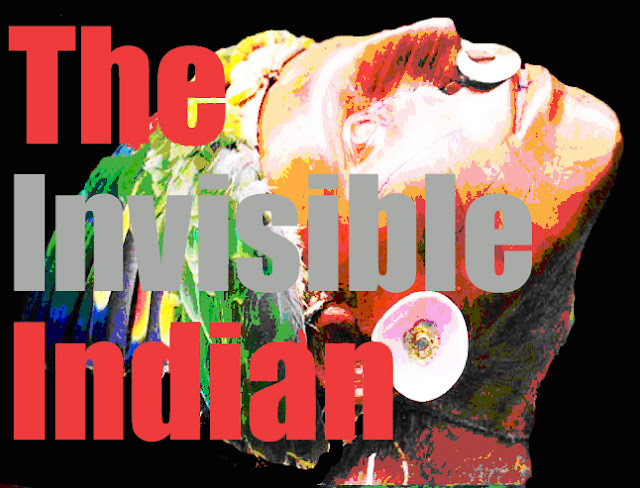
Copyright 2022 by Michael Auld (Yamaye)

“Invisible Indian” A graphic illustration that portrays the reality of the convenient invisibility of Native Americans from the National discourse, is based on guilt.


The Encounter Period  

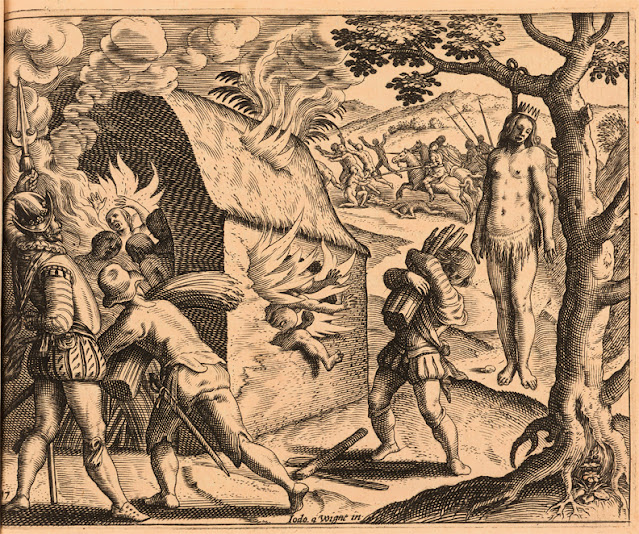
Print by Jodocus van Winghe, published in 1598 is of the Murder of Anacaona (Golden Flower) the Taino provincial leader of Jaragua, showing the carrying out of the order by Governor Nicolas de Ovando, successor to Columbus on the island of Hispaniola (Ayti Bohio/Kiskeya) in 1504. Anacaona, Queen of Jaragua had invited Ovando to a reception on her homeland. Ovando accepted, and upon arrival at Anacaona's large Caney (chief's house), he ordered his crossbowmen to surround the house of 100 assembled sub-kacikes. His men took Anacaona from the Caney, set it afire, and shot anyone attempting to escape. He offered Anacaona to become a concubine. She refused and was hanged. This Spanish pattern of annihilation of the Indigenous leadership was copied in the Conquest of the Americas.


The Role of Indigenous Women of the Americas

Indigenous women have always held a place of honor among their people. From Earth Mother to goddesses, tribal property owners, and matrilineal icons. Even our planet was seen as "Mother Earth.” Native women have occupied the highest rung in endemic societies.  However, after the arrival of the first Spanish Europeans, the Indigenous woman became survivors of violence and dismissal. The Caribbean was the first to experience this chauvinistic horror.
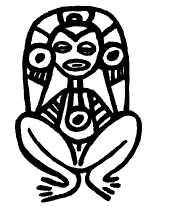


Atabey, the Taino virgin goddess of
childbirth and freshwaters.

HONORING OUR INDIGENOUS AMERINDIAN WOMEN

In March, we honor the First Women of the Americas, some who paid the ultimate price for leadership or for just being the first to, unfortunately, encounter a hemispheric invasion


The first recorded atrocity, a rape, occurred in 1493 on Columbus' return trip to the Caribbean. We know of her, but we do not know her name. She was a young Kalinago woman from Ay Ay, (meaning the "River" in Taino), a Leeward Caribbean Island which we now call St. Croix, (ironically meaning the "Holy Cross" in French). A similar concept to the Christ crucified on a cross, she was the first Indigenous victim of a Christian crime in her homeland. Michele da Cuneo flogged and raped an Amerindian woman. 


Surprised at the arrival of the Spanish ships, while in a Kalinago canoe and fighting off a boatload of Spanish seamen from Columbus’ flagship, one of whom she shot an arrow through his shield with such force that it penetrated three inches into the attacker's chest, killing him. After a skirmish, she was captured by da Cuneo, an Italian lieutenant and a childhood friend of Columbus’ from his flagship, one of the 17 to 19 arriving vessels. The ensuing rope whipping and rape took place in da Cuneo's cabin on the Admiral's flagship. Ripping her attacker with her nails, her loud screams brought no help from Columbus or his crew.
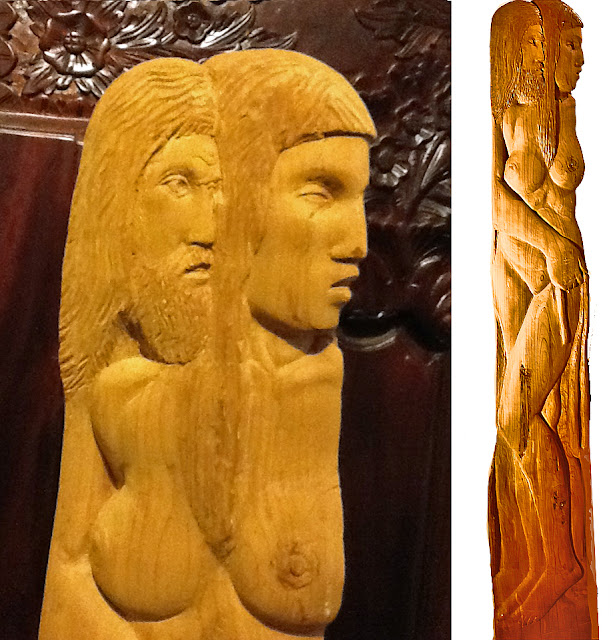

"Rape of a Kalinago Girl: 1493", Sculpture by the author


The first martyrdom of an Indigenous woman in our hemisphere to be recorded occurred in 1503 in Ayti Bohio, meaning "High Mountain Home," or Kiskeya, meaning "Mother of All Lands." Anacaona is our first named honoree who was the kacike or ruler of over 100 sub-kaciles in her province of Jaragua (Ha-rag-wah) located in today's Haiti on the second largest Caribbean Island. This island was the center of the Taino Civilization, whose vast Bagua, or the Caribbean Sea to the north, included hundreds of islands and cayaos (keys). In 1492, on the east shore of their northern island of Guanahni, or Island of the Iguana, land of the Lucayo or Lukku-Cari, i.e. "Small Island", they encountered men from Spain headed by the Italian wool merchant called Cristobal Colon by his Spanish employer, Queen Isabela. His real name was Cristoforo Colombo in his native Italian but was later Latinized as Christopher Columbus by English speakers.
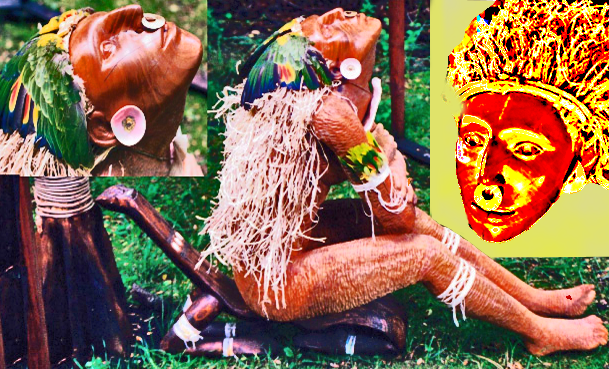
Above: Kacike Anacaona (seated on a ceremonial dujo stool) while in a cohoba trance communing with the ancestors. --By the author.

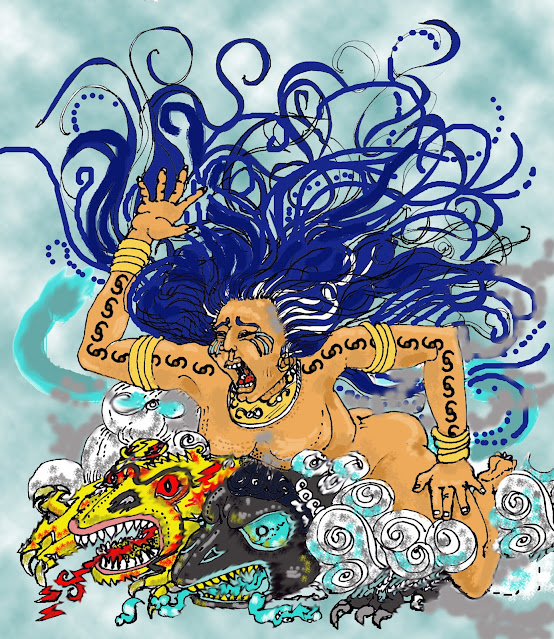
Below: A book illustration by the author of the hurakan/hurricane which is seen as an angry woman goddess, Guabancex, Rider of the Winds. She is part of a triad that includes the twins, GuatauBA! the Herald lightning and thunder. Coatrisque the Deluge, follows her yearly arrival from Africa’s Sahel Desert where she is born.


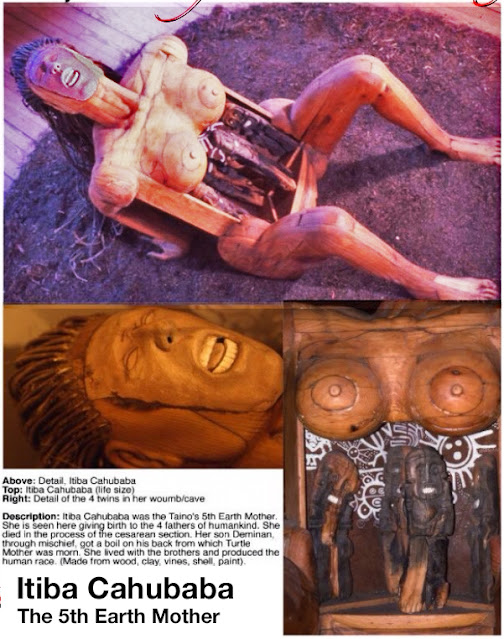
Above composite sculpture by the author.


CHESAPEAKE WOMEN IN 1585 

The Second Amerindian Pandemic

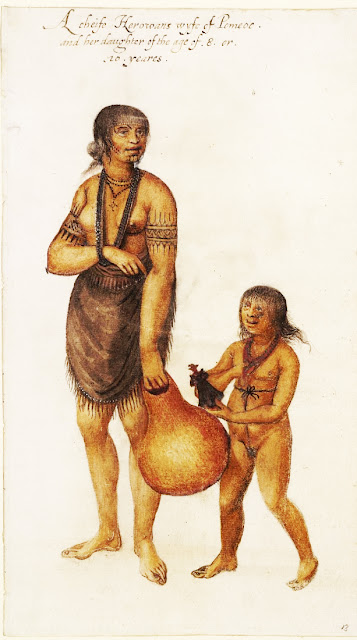
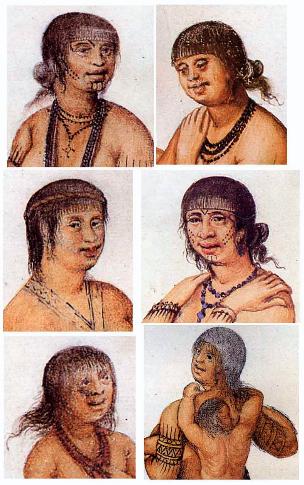
Ethnic watercolors by John White also included men. We must remember these women of the Chesapeake Bay region of Secotan who first encountered the English in 1585. They may not have lasted beyond a week after these watercolors were made. Villages were decimated by a European disease soon after being revisited by John White's expedition.


The Powhatan Paramountcy 1607 to the Present 

The Powhatan Paramountcy was the second Indigenous Encounter in North America in 1607. This is where the United States of America began. Founded as an eight Algonquian confederation by the first “Dreamer" or Powhatan I, his son, Wahunsenachaw was the second Powhatan who expanded the Algonquian political group into a 32-34 nation Paramountcy which the arriving English called a “Kingdom.” Their territory included affiliation with the Nanticoke or Kuskarawaoks people of Maryland and Delaware to the north. The ensuing conflicts between the Powhatans and the Virginia Company of England’s representatives and the English Crown ended in three Anglo-Powhatan Wars in Virginia, Maryland North Carolina, and Washington, DC. In suing for peace, Cockacoeske, the Queen of Pamunkey whose 1677 Treaty of Middle Plantation at Williamsburg, Virginia, ended the conflicts with the invading English and their ever-continuing violent expansion. This is the story of the great women of the Powhatan Paramountcy. 


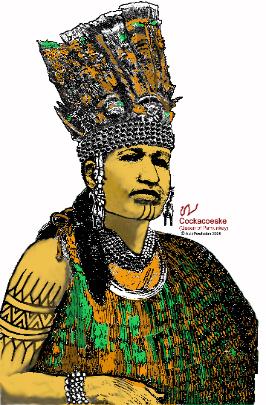
DC once had an Indigenous Queen,--Washington Post article. Illustration of the late Georgia Mills Boston Jessup (Pamunkey) as her relative Cockacoeske, Queen of Pamunkey. --By the author.


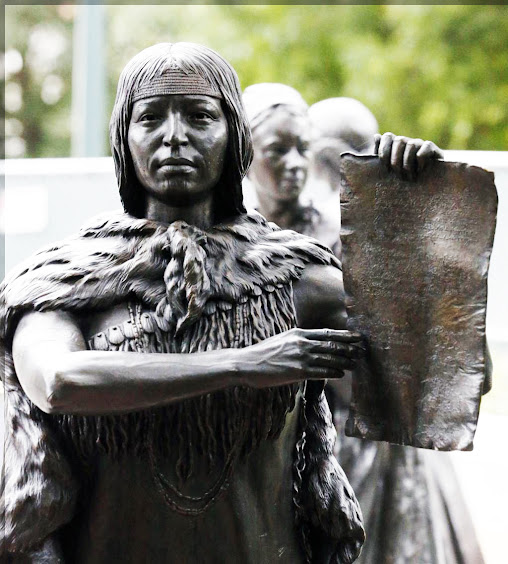
Sculpture of Pamunkey Queen, Cockacoeske in the honored Women’s Monument at Capitol Square, Richmond, VA. She holds the 1677 Treaty of Middle Plantation as the major signatory on behalf of her people and the many Indigenous nations under her governance. The treaty ended the last of the three Anglo-Powhatan Wars of Homeland Security and set the stage for the American Revolution.


Shaman” collage painting by Georgia Mills Boston Jessup a Pamunkey painter and ceramicist. The painting was used as an invitation to a family exhibit at the Fondo del Sol Museum in DC. The contents of a pouch incorporated into the painting, include spiritual objects from her cousin Pamunkey Chief Paul Miles’ medicine bag, given to Georgia by her late cousin, Chief Bill "Swift Eagle" Miles.


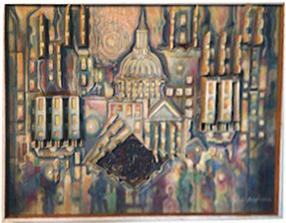
Rainy Night Downtown”, is a painting of her DC city hometown by Georgia Mills Boston Jessup. Included in the Permanent Collection of the National Museum of Women in the Arts, Washington, DC.


Urban Renewal”, is a collage painting by Georgia Mills Boston Jessup that comments on the removal of people of color in DC to make way for gentrification.


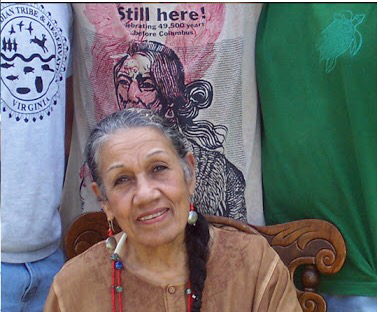
Georgia Mills Boston Jessup (Pamunkey) was an artist, teacher, and administrator from Washington, DC, and its Metropolitan Area. She was number 13 of 21 siblings and a family of over 29 members in various local and national arts disciplines.


Above: This is a video of a Land Acknowledgement given by Washingtonian Wisdom Keeper, Rose Powhatan a Pamunkey and Tauxenent descendant of the historic Powhatan Paramountcy in her yard in North West Washington, DC. Capitol Hill is known as the “Place of the Caucus” where Wahunsenachaw or Powhatan II, met in caucuses to promote solidarity with the surrounding Algonquian nations. Chroniclers during his lifetime said that “Powhatan never left his area.” The 32-34 nation Algonquian Paramountcy was governed by both women and men.
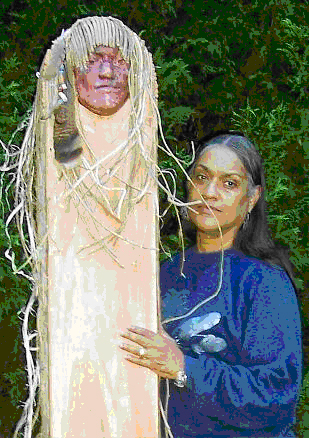


Above: Artist, tribal historian, and storyteller Rose Powhatan (Pamunkey/Tauxenent) with her “Firewoman Warrior” ancestor totem, Keziah Powhatan, the Tauxenent leader of the 1752 burning of the Fairfax County, Virginia courthouse. 

Below: Tysons Corner D.A.R. plaque about the event. Kezia's people's land was given to Lord Fairfax by his cousin the King of England. So, she and her warriors burned the building down. This story was passed down in her Fairfax County's extensive family.
http://


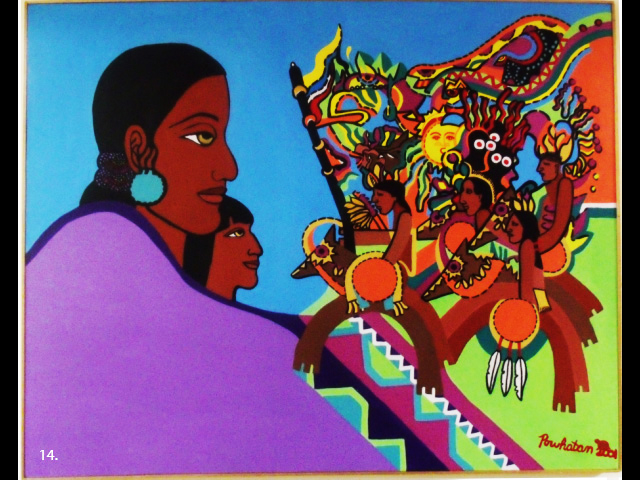
Storyteller” an acrylic painting by Rose Powhatan (Pamunkey/Tauxenent) is also an example of a mother passing on inspirational stories to her daughter. 


MYTH & REALITY

(1) Will the real Pocahontas please stand up!
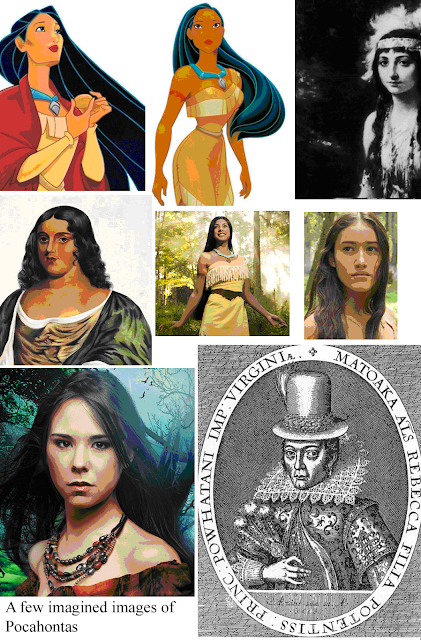
America’s iconic Native American has been mostly interpreted by non-family members for decades. All that we know is that she was a little girl of 11-years-old in 1607 when the 27-year-old English Captain John Smith arrived in Attan Akamik as an employee of the Virginia Company of London. Almost everything else is conjecture since she never spoke for herself. She is either idolized by Eurocentrists as a Christianized princess collaborator or despised by some Native Americans as a sellout of her father’s Powhatan Paramouncy’s territory. Or a victim of the Stockholm syndrome, where the kidnapped becomes a supporter of the kidnappers.

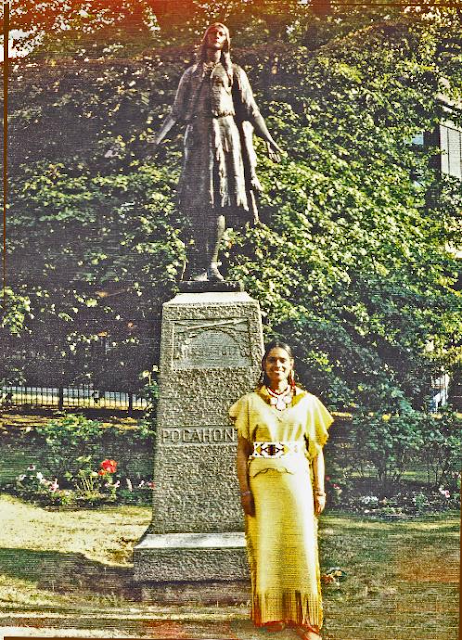
Rose Powhatan (Pamunkey/Tauxenent) stands next to one of two commissioned sculptures of Pocahontas. A Fulbright Scholar and exchange teacher for the school year 1994 to 1995 she also worked with the high school students at the St. Georges Church of England School, Gravesend, Kent, England,  Here she is next to her ancestral cousin, Pocahontas' monument at Gravesend, England in 1994.  The British acknowledged Native American princess is buried at the nearby St. Georges Church, possibly under the altar area, and is the town’s main tourist attraction.


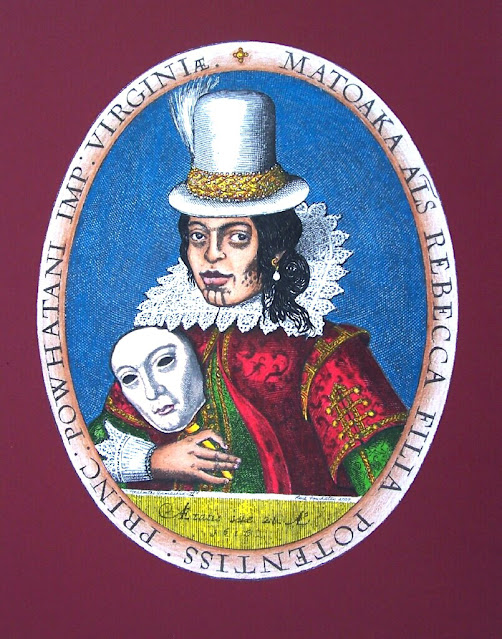
Rose Powhatan's “Pocahontas Unmasked” print by a Native American Pamunkey family member questions the portrayal of the iconic young woman’s physical interpretations. "Pocahontas was a full-blooded Native American young woman, not a European," the artist said.


(2) The Island of Women

Indigenous women in the Americas were seen by the arriving Spanish as earthly members of the place of unequaled beauty which their awestruck men called the Terrestrial Paradise, technically identified as the biblical Garden of Eden. This impression was concretized when Columbus first arrived on Guanahani (renamed San Salvador) in October of 1492. By sign language, he was introduced to the Taino epic of Matanino, the Island of Women, and Guanin, its twin Island of Gold. Father Pané later recorded this epic in more detail on Hispaniola.

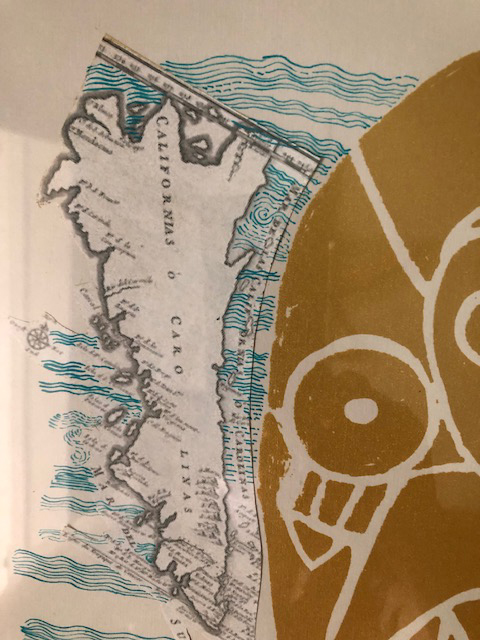
(Above): A montage print titled, "La California," with a Taino image of Atabey, the goddess and virgin mother of Yucahu, god of the sea, and the life-giving yuca or cassava. Her image is overlaid by an early Spanish woodcut of a drawing by Fernández de Oviedo, 1526 of the Taino method of panning for gold, as introduced to Europeans.--Silkscreen print by the author.

(Below): Left side enlargement showing the early Spanish map of La California as an island, thinking, as Hernan Cortez did in 1519 when he saw the California Mountains in the distance from Mexico's Baja California, after the conquest of Montezuma's Mexica or Aztecs. Cortez was familiar with the recently published Garci Rodríguez de Montalvo's book "La California." He thought that this was the abode of Queen Califia's golden island. Coincidentally, gold was later found in those California Mountains which caused the California Gold Rush.


An illustration of Queen Califia of the Island of "Black" Amazons called La California protected from men by griffins, and whose only weapons were made of gold. This story was adapted as Las Sergas de Esplandián (The Adventures of Esplandián) a popular novel written by Garci Rodríguez de Montalvo. It was probably adopted by the Spanish 16th-century novelist from Fray Ramón Pané’s recorded manuscript on the Caribbean Island of Hispaniola (Kiskeya/Ayti Bohio) titled "Account of the antiquities of the Indians." 

In about 1498 after the Tainos began attacking the Spanish invaders, Pané compiled and presented to Columbus his Relación acerca de las antigüedades de los indios ("Report about the antiquities of the Indians"). This account was known to have contained accurate and unbiased descriptions of the Taino beliefs and was used by Peter Martyr, las Casas, and Ferdinand Columbus.


  WOMEN OF POWER

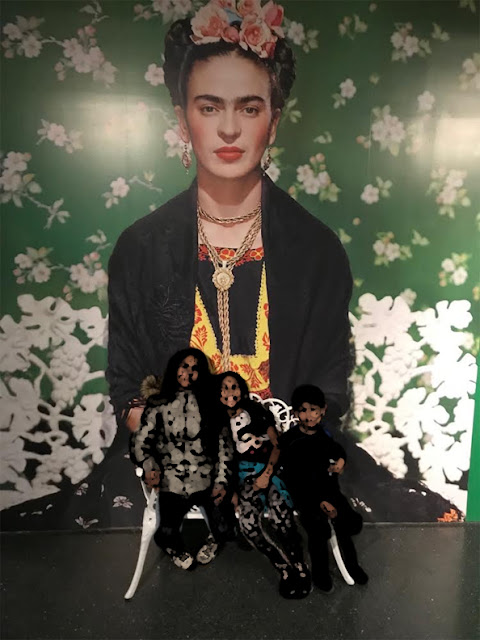
Frida Khalo was a Mexican painter, proud of her Indigenous ancestry and dressed in their style, whose feminism is still admired by many. She is celebrated in Mexico for her attention to Mexican and indigenous culture and by feminists abroad for her depiction of the female experience and form. 

"I paint self-portraits because I am so often alone because I am the person I know best."


http://

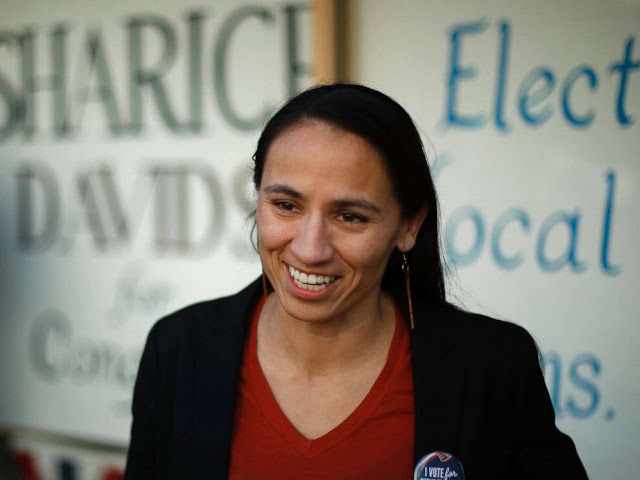
Representative Sharice Lynnette Davids (Ho-Chunk Nation of Wisconsin) was born May 22, 1980, was raised by a single mother, who served in the Army for 20 years. After graduating from Leavenworth High School, she worked her way through Johnson County Community College and the University of Missouri-Kansas City before earning a law degree from Cornell Law School. As a first-generation college student who worked the entire time she was in college, Rep. Davids understands the importance of quality public schools and affordable higher education. It is that foundation that allowed her to go on to a successful career, focused on economic and community development, which included time as a White House Fellow under President Barack Obama.

When she was sworn into the 116th Congress, Rep. Davids became one of the first two Native American women to serve in Congress.


Secretary Deb Haaland (Laguna Pueblo). Interior Secretary Deb Haaland made history when she became the first Native American to serve as a cabinet secretary. She is a member of the Pueblo of Laguna and a 35th generation New Mexican. 

Secretary Haaland grew up in a military family; her father was a 30-year combat Marine who was awarded the Silver Star Medal for saving six lives in Vietnam, and her mother is a Navy veteran who served as a federal employee for 25 years at the Bureau of Indian Affairs. As a military child, she attended 13 public schools before graduating from Highland High School in Albuquerque.  

As a single mother, Secretary Haaland volunteered at her child's pre-school to afford early childhood education. 


An Hour-long Congressional Condemnation of hatred by some men against women: https://youtu.be/jUIbIWgBWo8


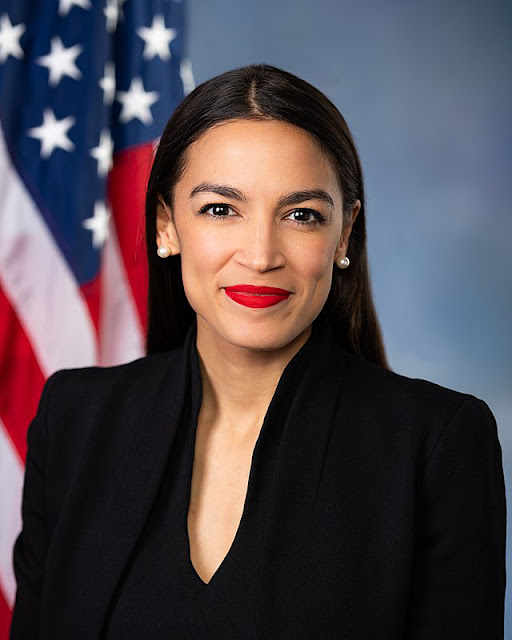
In January of 2019, Congresswoman Ocasio-Cortez who is descended from the Taino People of Puerto Rico (Borinquen) was sworn in as the youngest woman and youngest Latina ever to serve in Congress.   Her first piece of legislation was the Green New Deal resolution, which envisions a 10-year national mobilization, akin to FDR’s New Deal, that would put millions to work in good-paying, union jobs repairing the nation’s infrastructure, reducing air and water pollution, and fighting the intertwined economic, social, racial and climate crises crippling the country.

Over her first term, she introduced a total of 23 pieces of legislation. Among them is her Loan Shark Prevention Act, which would cap credit card interest rates at 15%. The Congresswoman also introduced a group of bills collectively titled ‘Just Society,’ which would raise the federal poverty line, include immigrants in social safety net programs, require federal contractors to pay a living wage, strengthen renters' rights, and decrease recidivism.

“There are some politicians who are very good on policy, and there are some politicians who are good communicators, and there are some politicians that have a way about them that relates very well to ordinary people. Alexandria has all three of those characteristics.” – Senator Bernie Sanders


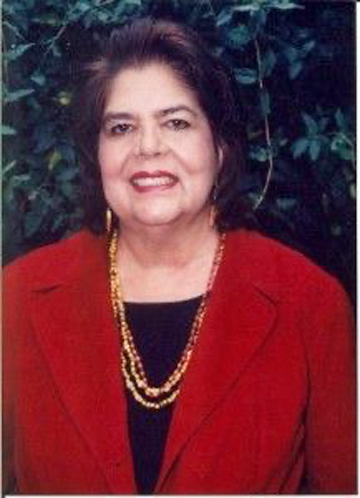
Wilma Mankiller, in full Wilma Pearl Mankiller, (born November 18, 1945, TahlequahOklahoma, U.S.—died April 6, 2010, Adair County, Oklahoma), Native American leader and activist, the first woman chief of a major tribe.

Mankiller was of Cherokee, Dutch, and Irish descent; the name Mankiller derives from the high military rank achieved by a Cherokee ancestor. https://www.womenshistory.org/education-resources/biographies/wilma-mankiller


“One of the things my parents taught me, and I'll always be grateful . . . is to not ever let anybody else define me; [but] for me to define myself. ” 


NOTES:

Some Indigenous ladies I adore...
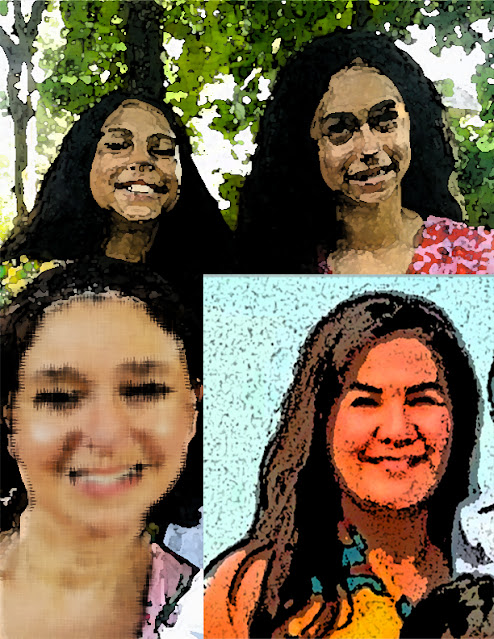
(Top) The Next Generation.

(Bottom Left) A Geriatrician mother of three, of Mixtec Mexican ancestry and who works with New York City's elderly patients heavily hit by COVID. 

(Bottom Right) A Navajo or Diné meaning "the People", and a mother of three who is promoting Indigenous cultures in the DC Metropolitan Area.


Tuesday, March 1, 2022

TRUTH and RECONCILIATION


An American Goal


Sculptural image of Wahunsenacawh or Powhatan ("Dreamer") the second major leader of the governmental body that became the Powhatan Paramountcy

The “basic objectives [is] truth, reconciliation, justice, memory, reparation, and recognition, [to] decide how these objectives should be met and whose needs should be served,” - 

Truth and Reconciliation Commission, 1995.


It is past time to act on the truths about Indigenous Amerindian loss of homeland. Land Acknowledgment in Canada, Australia, New Zealand, and now in some US venues is a start. However, both England and its freed American colony have never apologized to Native Americans for their near eradication, land grab, enslavement, human export, and exploitation of ancestral territories and hemispheric riches.

The earliest recorded eradication events in the Americas occurred in the fledgling Spanish Empire, which was first headquartered on the Caribbean island of Hispaniola (Haiti and the Dominican Republic). The Indigenous Taino names for this second largest Caribbean Island is Ayti Bohio (High Mountain Home) and Kiskeya (Mother of All Lands). There the estimated one million original souls in 1492, were reduced after 10 years by 968,000. They were “Taíno [who] had perished from enslavement, massacre, or disease.” (Hispaniola Case Study: 
Colonial Genocides: Date range: 1492 to 1514, https://gsp.yale.edu/)
 
One can multiply these numbers by the 23 countries that occupy 9.45 million square miles of our planet. Currently, with a total population of over 580 million people, most of whom are called “Indigena”, "mestizo" or "Hispanic." Many of these indigenous descended survivors of the Amerindian genocide were called "rapists and murderers" by past President Trump.


The Truth

Although the entire USA and its territories should be included in a national apology, we must start at America's beginning. The Powhatan People of the Virginia Territory, established by the Virginia Company of London, should be first in line for the proposed apology. This company's 1606 charter was revoked after just one year by James I, who assumed direct control of Virginia.  in British plans, their occupation of Powhatan lands began in1607. However, the final takeover of Powhatan and surrounding territories took 70 years with the signing of the 1677 Treaty of Middle Plantation (Williamsburg). During these seventy years, the indigenous people became the pandemic-ridden survivors topped off by wars of attrition and murder as evidenced by Nathaniel *Bacon's Rebellion.


Their painfully untimely demise is continually passed off by writers as some mysterious innocuous European derived diseases, “for which they had no immunity.” Amerindian victim-blaming for their Holocaust as a deficiency for some “compromised immune system,” is part of today’s avoided National guilt.

The Record

Let the Spanish make their own peace with the victims of their colonizer, Cristobal Colon.

Upon the first recorded European encroachment in our country, the victimized Powhatans in Ajakan of the Chesapeake were hanged from the yardarm by a Spanish crew. The Iberians had returned where they had previously kidnapped a "prince" from off the beach, taken him to Cuba and then to Spain. 

The kidnapped Powhatan prince was renamed  "Don Louis de Velasco," was thought by some writers to have been Powhatan II’s brother Opichancanough. He finally convinced the Spanish to return him home to fetch his people for Christian conversion and territorial theft. Instead, Don Louis returned with warriors and dispatched the kidnappers.

However, the English colonizers were first responsible for the demise of the Powhatan Paramountcy in the southern Virginia Territory while Pequot’s King Philip War in Connecticut and the subsequent deportation of many survivors were shipped to Bermuda. These Colonial atrocities included the Native American Slave Trade to the Caribbean Island sugar plantation colonies, prior to the change to African enslavement.

Reconciliation

Gratitude to the Indigenous Peoples of the Americas and their descendants is a basic requirement for healing. Colonial governments, private businesses, religious and educational institutions in Europe monetarily benefitted from the Amerindian genocide, as did other European countries who indirectly benefited from the crime. Since colonization the northern Eastern Hemisphere amassed untold wealth from the demise of indigenous civilizations in the Western Hemisphere. Those who wrote the history of this Holocaust use high sounding terms such as “The Age of Discovery, “The Age of Enlightenment,” and the resulting “Industrial Revolution” that were financed off the backs and riches of Amerindians and Africans.


The historical records are there. In America’s case, both England and the American Revolutionary inheritors need to fess up.

How Do We Fix This?


On July 10, 2015, Pope Francis Apologized to Indigenous Peoples for 'Grave Sins' against them.—https://indiancountrytoday.com/archive/pope-francis-apologizes-to-indigenous-peoples-for-grave-sins-of-colonialism-tlGAXDXgwkCkvmn10DjT3Q

Once the truth is finally confronted, absolution and atonement must follow. This was true after the dismantling of Apartheid in South Africa and the Catholic Church under Pope Francis apologized to the Indigenous people of the Americas for the Church’s role in the Amerindian Holocaust.

A monument and an official apology should be made to this continent’s First People who were at the brunt of the American invasion and the resulting epidemic. One man alone stands out as this symbol atonement.


Above: A simple sculptural recommendation for atoning remembrance.

This monumental concept is intended as an apology to Wahunsenacawh the Second Powhatan whose leadership of a vast paramountcy was violently curtailed by three seemingly simple acts; The destabilizing kidnapping of his favorite daughter, Pocahontas, the introduction of the North American Native American Slave, and the ensuing European introduced pandemic.

Invited survivors of this Holocaust should attend a public ceremony. This should include people from the historic Powhatan Paramountcy and the signatories of the 1677 Treaty of Middle Plantation, as well as the Pequots of King Philip’s War in Connecticut and those shipped to Bermuda.


Above:   is an example of what atonement could be between a Powhatan survivor and the British Crown while American governmental beneficiaries of the First North American encounter look on.

The photograph is of Chief Ken Adams, Upper Mattaponi Indian Tribe, who took part in welcoming Britain's Queen Elizabeth II to Virginia on the 400th anniversary of the establishment of Jamestown. Virginia Governor Tim Caine and First Lady Anne Holton look on.— Richmond, Virginia; May 3, 2007. Photo courtesy of the tribe. 

The Proof

So, America is still connected to its past

NOTES:
* Bacon.s Rebellion was a case of murder via misidentification.

Monday, November 1, 2021

HONORING THE HUMMINGBIRD


Messengers to the Spirits

 © by Michjael Auld

In a Taíno story, Agueybaba, Father Sky, turned a fly into a tiny honored messenger bird, the colibri or hummingbird. Who also is a healer and a symbol of rebirth.

In this hemisphere we tend to take the hummingbird for granted. In the northern climes most of 15 of the 365 types of these tropical birds fly north in a short time from Mexico and Central America to breeding grounds in the United States and Alaska. Some species stay as an endemic kind in their own island and their southern mainland homes. However, “the Ruby-throated Hummingbird, which weighs little more than a penny, can make the 500 mile journey across the Gulf of Mexico in less than a day.”  Except for the Anna’s Hummingbird which remains on the Pacific Coast all year round, certain varieties go back and forth following the flowering, insect and seeding seasons. 

The story of these magnificent birds was only known in the Americas until 1492, when the Spanish, arriving in the Caribbean who thought of them as witchcraft or as magical birds which could hover or fly backwards. These attitudes towards hummingbirds have continued to represent messengers, warriors, and spiritual beings in some Amerindian cultures, even until this day. Who are these creatures whose glittering feathers, first encountered in the Taíno culture of the Caribbean Americas, and were thought of by them as the representation of shimmering gold?


Figure 1: Titled, “Guanin” this hummingbird sculpture representing the Island of Gold, from the Taíno story’s symbol for guanin/gold, exemplified by the shimmering feathers of the sacred colibri/hummingbird, as a healing messenger of the gods. Called the Doctorbird in the island, this bird is both Jamaica’s national bird and a symbol for the Yamaye Guani Taíno nation of Yamayeka/Jamaica. Sculpture by the Author.


Figure 2: (AJamaica’s national bird, the scissors-tail hummer. (B) Symbol of the Jamaican Yamaye Taino’s Hummingbird Tribal Nation. (See the introduction by the Kacike Niborni Kaimam of Yukayeke Guanija https://youtu.be/p6gUtez4yEg


A STORY BY


Hummingbird (hum-ing-berd)

AColibrí /ko-lee-brí/ n. 1. The Taíno name for a small brightly colored bird of the Caribbean, North, Central, and South America that can beat its wings rapidly, making a zum-zum or humming sound. 2. Kolibrie is the Spanish, Portuguese, Italian and Dutch words for hummingbird originating from the Taíno language. Family: Trochilidae 3. also Zum Zum, (from Cuban Taíno) apparently from the sound made by the bird’s wings while in flight. 

B. Called the hummingbird in English /húming-bird/ n (a). An English word which is derived from the humming sound made by the bird’s rapidly beating wings. (b) The tiny hovering bird called colibrí by the Taíno. (c). A small jewel colored bird found only in the Americas related to swifts and having narrow fast beating wings, a long slender bill, and extended tubular tongue for drinking nectar. (d). Also called a “hummer” by some American bird lovers.

How hummingbirds are viewed

Figure 3: Hummingbird Images: (1) Huitzilopochtli, the Mexica’s (Mé-she-ka) hummingbird-warrior and sun-god. (2) Jamaica’s national bird, the Stream-tailed or “doctorbird”. (3) Cuba’s bumblebee-sized hummingbird superimposed on an image of the biggest hummer, the swift-sized South American Patagonia gigas. (4) Jamaican Taíno sculpture of what appears to be a hummingbird man. (5) A Victorian woman wearing a hat with stuffed hummingbirds attached to it. (6) Gigantic image of a hummingbird from the famous Nazca of the Pampa region of Peru, South America. This etching is one of 300 large linear earthwork designs created between 200 BC and 600 AD. The images were made by scraping away the top layer of iron-oxide coated surface pebbles to reveal the lighter color underneath in order to create drawings that are only recognizable from the sky. (Nazca Lines and Culture, http://www.crystalinks.com/nazca.html). (7) Hummingbird Magic for attracting the opposite sex. Like Polvo de Chuparrosa or "powdered hummingbird" this is an image of a premixed cologne or perfume, one of the items along with votive candles and amulets, sold in Mexico and South America.
 
The hummingbird is believed to be reincarnated warriors, emissaries to deities, identified with a supreme god of the sun and war, worn as earrings by chiefs, sought after for their jeweled pelts by shamen and Victorians, used as love potions, and the major character of many indigenous American mythologies. These are only a few of the descriptive qualities of the world's smallest bird. This indigenous native of the Americas was called colibri and zum-zum by the Taíno and hummingbird by English speakers. The name colibri is still used in Spanish since they were the first non-natives in the Americas to see a bird which they too gave mythical qualities. Hummingbirds are comprised of 365 species and 16 of these live in the Caribbean. They are the second largest family of birds in the Western hemisphere and are found throughout the Americas from Tierra del Fuego in the south to the Arctic Circle in the north. nown as "feathered jewels" the hummingbird has a mystical reputation. The light reflective quality of its tiny feathers turns to dark hues in the shadow and become brilliant faceted colors in the sunlight. The Taíno associated the colibri with the glitter of their highly prized 14k gold called guanin. The reflective sheen of the hummingbird's feathers was like the bright copper-yellow guanin used to render the eyes of some sculptures. Metallic brilliance was associated with a spiritual gate between two worlds. The reflective sheen provided a crossable bridge into the cohoba world of the cemis (spiritual icons). To the Taínos the hummingbird was seen as an important crescent shaped symbol and was associated with similar forms such as the quarter moon and the rainbow. An image of this geometric shape was also achieved when the male of some specie fly in a perfect arc during its mating ritual.


"Aruacs (Taínos) regarded the Humming-bird as the incarnation of their dead warriors, and the name God-bird also applied to it, and the Supernatural awe attached to it suggests that the Amerindian belief has been taken up by the Blacks in a modified form, and that 'doctor-bird' is a 'medicine man’s bird'."

The Jamaican national bird is the specie (Trochilus polytmus) which is the unique Streamtailed hummingbird called a doctorbird. Hummers in Jamaica are called doctorbirds since their beaks are used like a doctor's lance, when collecting nectar and insects from flowers, and may be a loaned Taíno concept. The male of this specie has two long, black tail feathers which make the bird measure 10 inches in length. As noted above in the 1847 description, the Jamaican folk mythology surrounding the doctorbird seemed to have Taíno origins. One Jamaican folk song warns, "Doctor bud a cunny bud, a hard bud fi dead". Or, “a hummingbird is a cunning bird which is difficult to kill.”


Figure 4: Images of  Huitzilopochtli the Mexica “Hummingbird of the South,” or the “Blue Hummingbird on the Left.”

A similar belief by the Aztecs (or Mexica pronounced, Me-shee-ká) was that Huitzilopochtli (Wit-see-low-poach-tlee), the warrior sun god, was associated with the hummingbird. They believed those four years after dying in battle, or as a sacrifice, the spirit of the warriors left the brilliant retinue of the sun god to forever live in the bodies of hummingbirds. Hummingbirds were placed on the graves of warriors.

The ferocious spirit of the hummingbird can cause it to attack an intruding hawk and even humans. The added solitary habit of this territorial bird is, as seen, is identified with Huitzilopochtli. The first part of this Mexica god's name Huetzilin means hummingbird and he is sometimes depicted as this bird. The second half of his name opochtli, means "from the deep south" or the spirit world. In his Nahuat (spiritual) disguise he appears as an eagle. He is the sun, a relentless warrior-god and each morning he rises in the east to subdue those siblings who had plotted his death while still in his mother's womb, his sister is the moon and his brothers are the stars. He was born fully grown and vanquishes them each day. Among the Maya there is also a god who is in the form of a hummingbird.

The Mayan creation story goes, that “When they thought they had completed the job of construction of the universe (again reinforcing the fallibility of Mayan gods), they realized they had failed to do something very significant. They had forgotten to provide a messenger to transport their thoughts and desires from one place to another. For this new creation, the Mayan gods decided to create their messenger with something special. They took a jade stone and began to carve in it an arrow. This arrow was designed to represent a journey. After a few days, the stone arrow was ready. When they blew on the stone to get rid of the dust caused by their carving, they blew so hard that it flew into the sky. As the arrow flew, it turned into a beautiful multicolored hummingbird which they called Al xts'unu'um.”-- https://www.animalwised.com/the-mayan-hummingbird-legend-gift-to-the-hummingbird-2012.html

To conserve the high energy used for darting and flying it is the only bird that can become torpid. This habit of going into a deep sleep of suspended animation when resting at night and its reinvigoration by the morning sun's rays is associated with attributes of "reincarnation". The use of its beak to penetrate flowers is associated with powers of healing and love. Amulets were made from body parts of the hummingbird and worn in medicine bags (that are still used as love potions in some areas of Central America). The Arawaks of Venezuela, who are related to the Taínos, believed that their ancestors obtained their first tobacco seeds from Trinidad through the ploy of a hummingbird. There are hummingbird tales from the Taíno, Apache, Aztec, Maya, Mohave, Chayma, Navajo, Hopi, Zuni, Cherokee, Cochti and many more peoples of the Americas.

Figure 5: North American hummingbird design.


In the 15th century Castilians (Spanish) in the Caribbean saw the hummingbird for the first time. They were fascinated with its diminutive size and brilliant, iridescent colors. The birds were compared with precious stones and gems which have given rise to such names as 'topaz', 'sapphire' and 'ruby'. They wrote that the hummingbird never landed and even nested in the sky. Queen Isabella of Spain, Columbus' benefactor, was told by the Spanish upon their return from the Caribbean that the hummingbird was a cross between a bird and an insect. Specimens were taken to Europe as part of the curious objects from the "New World". Both scientists and the public were captivated by this unusual bird. Stuffed hummingbirds were in great demand through the Victorian era. In 1888 400,000 hummingbird skins were sold as clothes decoration and for jewelry in London alone. Unfortunately, this was one of the ways that the variety within the hummingbird specie was scientifically counted. During this era having encased specimens to adorn one's home was the rage. The exportation of millions of hummingbird skins from the Americas has dramatically slowed but contemporary habitat destruction has endangered the species. Live specimens are difficult to keep and some that were more hardy in captivity have been exported to areas outside of the Americas.

Upon the arrival to the Americas of English speaking Europeans this unique bird was named for the humming sound made by its rapidly moving wings. The wings of each type of bird make a different humming sound. They are most numerous in Columbia and Ecuador where 130 species exist. Hummingbirds are related to swifts and belong to the order Apodiformes and the family Trochilidae. The largest is the Giant Patagona gigas of western South America and is as big as a large sparrow while the smallest, which could pass for a bumble bee, is the Bee hummingbird (called Guani by the Taíno) from Cuba in the Caribbean. Because of their speed some are found impaled on thorns. Their size causes them to fall prey to frogs, praying mantis, and spider's webs (which some hummers use as material for building nests).

The Ruby-throated hummingbird (Archilochus colubris) is the most widely known of the species. It winters in the Caribbean and Central America and in the Spring migrates to eastern North America (from Labrador to eastern Mexico and westward to central South Dakota) where it breeds. During the Fall the Ruby-throated return south in swarms. From spring to fall the Rufous hummingbird flies 2,000 miles between Central America and Alaska.


Of the 16 specie in the Caribbean some are only found on one particular island. For example, the worlds smallest bird, the male bee hummingbird (Mellisuga helenae), is only found in certain parts of Cuba. The Bee hummingbird measures just over two inches from bill to tail (the giant hummer is over 8 inches long). The male which weighs around two grams is slightly smaller than the female. The female is shimmering green, matte taupe with flecks of golden yellow. The male is a showier taupe, with black, aqua, and beads of rose colored head and neck feathers.

The humming bird is the only animal to have truly mastered flight and it has no match in aerobatics. For example, the wings of the ruby-throated hummer normally beat 90 times per second and 200 times per second during courtship. Few other birds can fly backwards and upside down and hover like the hummingbird. It is able to achieve its unusual flying ability because it is capable of rotating the main parts of its wing in all directions. By positioning its body almost vertically and tracing a figure-eight with the tips of its wings, it produces lift and hovers. In order to maintain its flying performance the bird must consume its weight in food each day.

It feeds on nectar which provides high energy sugars and will eatch some insects and spiders. The ability to collect the quantity of needed nectar comes from the variety of flowers they visit. For example, the ruby-throated hummingbird is attracted to at least 31 different flowers. They can be lured to feeders which contain red-colored sugar water. Some plants depend on the hummingbird for pollination. Pollen is transferred to the bird via the stamen which comes in contact with the bird's head during feeding. Many North Americans are avid hummingbird watchers who hang out feeders for the yearly migrants. A few hummingbirds have been known to hang around in northern climes during the winter. A news story in January, 2000 reported a case in Virginia where a Rufus hummer (rarely seen in the Eastern United States) continued to visit a local feeder which then attracted many hummingbird watchers to the site. There are many books and sites on the Internet with stories and information on hummingbirds.

Figure 6: Jamaican hummingbird sculpture, with details, honoring Sir Alexander Bustamante the island's first prime minister who had Taino ancestry. Materials: welded bicycle parts; inlaid etched and colored Plexiglass; One Dollar bill. By the author,


Sunday, September 12, 2021

Surviving Document Genocide

 FROM THE BOOKTHE PEOPLE WHO STAYED: Southeastern Indian Writing After the Removal)

© 1999 by Rose Powhatan


[Document genocide -dok’y mont’ jen’ sid’-, n. 1. the deliberate extermination of a race of people through changing information about them in an official paper 
* See below: Racial Integrity Act of 1924.]


The author at the Pocahontas statue in 1995, Gravesend,
Kent, England


The author on a research grant viewing the original "Powhatan's Mantle" at the Ashmolean Museum, Oxford University, England.


Above: Front and back covers views of the book. A 404 page book published by the University of Oclahoma Press, October 12, 2012

Rose Powhatan (Pamunkey/ Tauxenent/Dogue) is a member of the Pamunkey Tribe of Virginia via her mother’s family and Assistant to the Chief of theTauxenents (Dogues) via her father’s family. A teacher for more than thirty years both in the Washington, D.C. Area and the United Kingdom. She is an elder in theInter-tribal Women's Circle of Virginia; the American Indian Society of Washington, DC; a prominent artist, tribal historian, curriculum writer and storyteller; who has had many exhibits of her work throughout the United States and England. She holds B.F.A.(cum lade) and M.A. degrees from Howard University. She has done extensive graduate work in history, humanities, education and administration at universities in the USA and the UK. Powhatan has served on numerous boards, including the Maryland Commission on Indian Affairs, American Association of Museums, the John F. Kennedy Center for the Performing Arts, and is a member of the American Indianan Society of Washington, D.C. She has published articles in journals and newspapers, such as The Sun (Baltimore), Kent Today (Gravesend, Danford, England), The London Times, and The Washington Post. Her film credits include: Cultural Consultant on the movie and role as a clan mother in "The New World"; Acting in the role of Crispus Attucks' Natick Indian mother in the HBO mini series, "John Adams"; She has appeared in a number of film documentaries including one by the Jamestown Settlement Park on the Powhatan Confederacy. She is currently featured along with one of her totems in an exhibit on the "Tauxenent Indians" of Fairfax County at the Riverbend Park, Great Falls, Virginia.


Here I am, at 3:30 A.M., the day before the deadline for submitting this story, and the very morning of the first family reunion of my father’s family that’s not a funeral. (Although I was enrolled as a member of the Pamunkey Indian Nation of King William County, Virginia, by my late cousin Chief William “Swift Eagle” Miles, through my mother, my father’s family is one of two families historically documented as “Indian” indigenous to Fairfax County.) I still can’t decide what to write about in relation to what it’s like to be officially recognized as an Indian outside the indigenous community thanks to a cartoon movie about my ancestors.

Document genocide regulates your relationship to others with whom you interact on a daily basis. It’s not easy to be upbeat about your tribal identity when most people around you constantly remind you that you are not supposed to exist. Even well-intentioned librarians are smug in their knowing responses to my requests for information about Indians indigenous to my tribe’s ancestral home region. They tell me that my ancestors became extinct through contact with European and African germs. When I identify myself as an enrolled Pamunkey Indian, they act sanctimonious and try to correct me. They tell me I must be a Cherokee or a Blackfoot. I’m told that I’m extinct, since all Indians indigenous to the Washington, D.C., Maryland, and northern Virginia region became extinct “hundreds of years ago.” “Government Indians” who have come to Washington to work at the
Bureau of Indian Affairs and other federal agencies play the same game with me. Why, they even form social clubs and perpetuate information about the people in the “official” organization mission statements. Supposedly, the main reason for starting such organizations is because, in their view, “there were no Indians in the region” despite the fact that many members of one such organization have repeatedly been shown hospitality by Virginia tribes, invited to enjoy the amenities of the reservations (the Pamunkey and Mattaponi reservations, the two oldest in the United States.)


New Indian arrivals in my home area constantly inform me that “back on the rez” they have been told that there are no Indians east of the Mississippi River. In response, I frequently reply to their ignorance by informing that, on the contrary, there are still many here, and some are descendants of warriors who fought long and hard battles against the invasion of our homeland. I encourage these Western Indians to return home and thank God that, because of us Eastern Indians, their ancestors were given extra time to enjoy their culture before the onslaught of a European ethnocentrism that believed in destroying all vestiges of indigenous culture whenever and wherever they found it. Southeastern indigenous people paid a very high price for the misfortune of being the first to live in close proximity to the first permanent English settlement in America. While the English did indeed come here for better opportunities than existed for them back in the old country, you might say that they actually bore a close resemblance to a later group often found in the region, those known as “Carpetbaggers.”

Growing up under document genocide requires constant vigilance if you intend to be a survivor. Residing in the Washington, D.C., and suburban Fairfax County, Virginia, area makes you painfully aware of the insidiousness of document genocide. Whenever you fill out forms requiring you to identify a racial or ethnic designation, you are challenged by the intake personnel. Since I’m a “carded” Indian, I show them my official tribal identification. Other Indians who lack the same papers generally have their identities changed, after having endured a condescending lecture on how they should be proud to be a member of the
race to which the clerk’s “eyeball test” has thus relegated them. I have also had the personal experience of having had my race changed without my knowledge. I’ve found out about it later on when I’ve gone back to get copies of a particular official document. The Washington, D.C., Vital Statistics Office once informed me that I would have to retain the services of an attorney if I wanted to correct the misinformation appearing on my records.

Oh, I’m a pro when it comes to administering, as well as taking the “eyeball test.” I have been teaching school in Washington since February of 1973. Every year, homeroom teachers are asked to fill out an official ethnic designation “head count” form to identify the races of the students in their classrooms. Teachers are instructed to survey the class, and then, by casually glancing at the students, write down on the form how they “fit” in the various racial classifications. One year, I asked students to raise their hands if they knew they had a family history of descendants from indigenous American ancestors. Most of the students raised their hands in affirmation of having Indian ancestors, I wasn’t surprised. When I was appointed by the secretary of the interior to the nine-member Underground Railroad Network to Freedom Nation Committee, I engaged in in-depth research on African displacement in the American South. The committee’s findings revealed that since the overwhelming majority of Africans brought to America were male, and since so many male Indians had been killed in conflict with invading colonists or made into slaves and absorbed into African slave groups, it generally holds that most African Americans claiming Indian ancestry will cite a particular Indian woman in their lineage to show their claim to Indian heritage. European Americans like to refer to this country as the “New World.” More appropriately, it should be called the “Widowed World”. Countless Indians are “hiding out” or “passing” in African and European American communities, due in great part to the eternal shame of the legacy of slavery. To add to this travesty is the recent trend of calling legally enrolled Indian people “black Indians” instead of their more correct tribal names. Misguided authors in search of a quick buck or instant public attention perpetuate this racist misnomer.


“Where are you from honey?” Is the question I have been asked my entire life. It is a question that is never asked of me by indigenous people. Nonindigenous Americans have made me conscious that I don’t “fit in” no matter where I go. Most people assume I am a Latina or I’ve recently arrived from the subcontinent of India. Hispanic people speak to me in Spanish and grow angry or impatient with me when I respond to them in English. Continental Indians are accepting of me when I am by myself, but frown when they see me with my Taíno Jamaican husband. I’m not surprised at both groups’ reactions to me. It’s a commonly held joke in the Indian community that Latino people are really Indian cousins from the South, coming up North to help us repopulate the United States of America with Indian people. As for mistaken Hindu Indian identity, one can always remember that Christopher Columbus made the same mistake when he landed in the Caribbean and encountered the Taíno (one of several Arawak-speaking tribes) and Carib people. We have all been called Indians ever since that fateful encounter.

In the school year of 1994-1995, when I was on a Fulbright Teacher Exchange Fellowship to the United Kingdom, a colleague from Spain told me that I was called an “India” whereas someone from India was called an “Indu”. It would seem as though the Spanish are still confused about who we are. I found that the Brits and Africans in the UK also had the same problem in recognizing my true identity. After each of the three times I had been mugged in London, the police reported the incidents as “Paki-bashings,” a term used to designate crimes perpetuated against Southeast Asians.

My most memorable and positive experience during my Fulbright year was due mainly to my ancestral cousin, Pocahontas. Oh, I know what you’re thinking — “Here we go, back to the Disney cartoon story:” No, it’s not at all related to make-believe. After the last time I had been assaulted in London, I decided to go to Gravesend, Kent, where Pocahontas is buried in the St. George’s Church of England sanctuary. I wanted to lay some flowers at the foot of the statue erected to her memory (the statue is a twin to the one erected at the original site of Jamestown, Virginia), and pray, since she was the closest link to home that I had in England. I had initially planned to go to Gravesend on March 21, 1995, which would have coincided with the anniversary of her death date in 1617. There was a mix-up at the railroad station, and I wasn’t able to complete my journey. As a result, I was a day late arriving in Gravesend. However, March 22nd was a more personally significant day for me since it is the day, in 1622, that Opechancanough (brother of Powhatan, the father of Pocahontas, and his successor—because of his place in the matrilineal line of descent—as head of the Powhatan Confederacy, following Powhatan’s death in 1618) launched his war against English imperialists in Virginia.

When I arrived at St. George’s, the church just happened to be open for a special service, although it was usually closed on that day of the week. I went inside and identified myself to the pastor, the Reverend David Willey. He seemed genuinely glad to meet me. He told me about a special teacher at the church named Di Coleman, who was currently writing a play in honor of the 400th anniversary of Pocahontas’s birth. He said that she would welcome my help with the production and that the children of the church’s school would benefit from my working with them. I called the school and received permission from Head Teacher Jean Bannister to give a lecture at the school and to work with the Resolution Theater Group, directed and sponsored by Di Coleman. I assisted Ms. Coleman as cultural consultant, set designer, and costume designer, and it was truly a godsend experience.

The experience, however, stands out in stark contrast with that of my initial dealings with the Disney Corporation when they began their work on Pocahontas. Soon after I had agreed to work with them as an advisor, when I insisted the true story of Pocahontas should be told and not the fantasy it became, I was dismissed. Disney eventually hired one of my cousins to work on the movie. She later pretended not to know that Disney would deviate from actual historical fact in order to fabricate the love story between Pocahontas and John Smith. The movie was universally panned by well-informed members of the indigenous community when it was released. My cousin benefited from her collaboration with Disney by being able to charge higher fees for appearances as an entertainer.

My affiliation with the staff and students at St. George’s and Di Coleman remains one of the highlights of my life. There I was, thousands of miles from home, being accorded respect and recognition that I had never experienced in my homeland. At the end of the historic performance of the Pocahontas commemorative production (which was also performed at other locations in England before it went on to the International Folk Festival in Scotland), I marveled at how far I had come to receive such respect for who I was, instead of the ridicule that is commonplace in the United States. I thanked Head Teacher Jean Bannister and the people of Gravesend for extending hospitality to me in the same spirit of humanity that they held for my ancestral cousin Pocahontas. I felt as though I was partially repaying their kindness to her through the work I was engaged in with their children. I was fortunate that document genocide against me and my people did not extend to the town of Gravesend. The Virginia Indian presence is a viable part of the ongoing, living history of the town. Our history is shared by them as a legitimate source of cultural tourism and a source of pride in themselves.

Where do I go from here? As an educator and curriculum writer, I lecture and write about the history and cultural retentions of my people. I’m an active member of the “powwow circuit:" and I set up exhibits and displays, which celebrate the cultural possessions of my people. I serve on numerous historic, educational, and cultural boards, where I can have a direct impact on information and participatory events that are made available to both regional and national audiences. I’m both a Washington Teachers’ Union building representative and a member of the Local School Restructuring Team, given the mandate to improve
education for young people at the grassroots level. As a practicing professional artist, my culturally based artwork is exhibited through numerous venues and is, at present, touring the country in a show commemorating seven decades of American art. I’m the founder/director of the Powhatan Museum and the Center for Indigenous Culture in Washington, which is affiliated with the City Museum of Washington. I’m the mother of three sons, all of whom are dedicated to do all they can to help eradicate document genocide that is directed towards indigenous Americans in courtrooms, schoolrooms, living rooms, and film-screening rooms in this country. My never-ending battle continues, but I am determined that my people and I will survive document genocide.
===============================================

The Racial Integrity Act of 1924

[In addition to “unintended” extermination of Indigenous Americans by foreign pathogens, the intentional eradication of Amerindians by the various European powers had begun with the first “illegal aliens” (the Spanish in the Caribbean) who began arriving in the Americas in 1492. Switch the numbers around and the 1924 Act to Preserve Racial Integrity was a 20th century attempt by the Virginia Government to complete the job that they had begun after both the American Revolution and the Civil War. This 1924 Act had wide impact beyond the borders of the state of Virginia. The most recent attempts to restrict increase Amerindian DNA in the United States is hidden in the issue of “Illegal Aliens” living in Virginia and those crossing the southern border of the United States of America. Fortunately, “that horse has already left the barn”. By moving to the next slot of racial dominance in the United States, Amerindian DNA via the racial classification of so-called “Hispanic” is well on its way to once again dominate North America as it has already rightfully done in South and Central America. It took the Spanish seven centuries to wrestle their country back from the Moorish Arabs of North Africa, who had introduced other forms of technological
“advancement” and cultural variations to Christian Spain. Maybe it will take the Amerindian a shorter time to regain dominance in their hemisphere.]

1. Be it enacted by the General Assembly of Virginia, That the State Registrar of Vital Statistics may as soon as practicable after the taking effect of this act, prepare a form whereon the racial composition of any individual, as Caucasian, negro, Mongolian, American Indian, Asiatic Indian, Malay, or any mixture thereof, or any other non-Caucasic strains, and if there be any mixture, then the racial composition of the parents and other ancestors, in so far as ascertainable, so as to show in what generation such mixture occurred, may be certified by such individual, which form shall be known as a registration certificate. The State Registrar may supply to each local registrar a sufficient number of such forms for the purpose of this act; each local registrar may personally or by deputy, as soon as possible after receiving said forms, have made thereon in duplicate a certificate of the racial composition as aforesaid, of each person resident in his district, who so desires, born before June fourteenth, nineteen hundred and twelve, which certificate shall be made over the signature of said person, or in the case of children under fourteen years of age, over the signature of a parent, guardian, or other person standing in loco parentis. One of said certificates for each person thus registering in every district shall be forwarded to the State Registrar for his files; the other shall be kept on file by the local registrar.

Every local registrar may, as soon as practicable, have such registration certificate made by or for each person in his district who so desires, born before June fourteen, nineteen hundred and twelve, for whom he has not on file a registration certificate, or a birth certificate.

2. It shall be a felony for any person wilfully or knowingly to make a registration certificate false as to color or race. The wilful making of a false registration or birth certificate shall be punished by confinement in the penitentiary for one year.

3. For each registration certificate properly made and returned to the State Registrar, the local registrar returning the same
shall be entitled to a fee of twenty-five cents, to be paid by the registrant. Application for registration and for transcript may be made direct to the State Registrar, who may retain the fee for expenses of his office.

4. No marriage license shall be granted until the clerk or deputy clerk has reasonable assurance that the statements as to color of both man and woman are correct.


If there is reasonable cause to disbelieve that applicants are of pure white race, when that fact is stated, the clerk or deputy clerk shall withhold the granting of the license until satisfactory proof is produced that both applicants are "white persons" as provided for in this act.

The clerk or deputy clerk shall use the same care to assure himself that both applicants are colored, when that fact is claimed.

5. It shall hereafter be unlawful for any white person in this State to marry any save a white person, or a person with no other admixture of blood than white and American Indian. For the purpose of this act, the term "white person" shall apply only to the person who has no trace whatsoever of any blood other than Caucasian; but persons who have one-sixteenth or less of the blood of the American Indian and have no other non-Caucasic blood shall be deemed to be white persons. All laws heretofore passed and now in effect regarding the intermarriage of white and colored persons shall apply to marriages prohibited by this act.

6. For carrying out the purposes of this act and to provide the necessary clerical assistance, postage and other expenses of the State Registrar of Vital Statistics, twenty per cent of the fees received by local registrars under this act shall be paid to the State Bureau of Vital Statistics, which may be expended by the said bureau for the purposes of this act.

7. All acts or parts of acts inconsistent with this act are, to the extent of such inconsistency, hereby repealed.

Saturday, August 28, 2021

The Goddess of the Hurricane

By Michael Auld 

 The Caribbean and the US East Coast have been hit with a number of hurricanes this year. Is it just one entity responsible or is it the multiple named Tempests of Shakespeare’s imagination? I’ll go with the oldest interpretation of just one; the Taíno angry goddess Guabancex and her two accomplices.


Figure 1: Guabancex the Hurakan is the ancient Taíno’s Angry Woman Goddess, Rider of the Winds. Here the hurakan/hurricane is portrayed as three entities of a warning, destruction by wind and water. Her yearly job is to clean the Earth of accumulated debris and bring renewal. – Image of a 4’ x 3’ 8” mixed media wall sculpture by the author, made from fractured ceramic, cherry wood, wisteria vines and metallic copper paint.


We are in the middle of Global Warming which has brought an angry goddess into our hemisphere more than just once this year. As if we have not learned our lesson of destroying the planet, she comes as a reminder of our errant ways. To the Taíno, this is normally the cleansing season of the very displeased Guabancex the Hurakan. Born in the Sahel Desert of North Africa, she, is our hurricane deity who has come to our area for millennia. Twin brothers accompany the Angry Woman Goddess, the Rider of the Winds. The Taíno believed that GuatauBa! the thunderous lightening Herald announces her pending arrival. While his brother, Coatrisque, the dangerous Deluge from the mountains, cleans up after Guabancex blows rotting things down. We humans just happen to get in their way.


 THE CARIBBEAN HURRICANE 

  •  Huraca’n (uh-ra-kah-an), Taíno. 
  • Huracan (uh-ra-kahn), Spanish. 
  • Hurricane (hurry-cane) English. 

  • Hura = wind + Ca'n = center, i.e., the Center of the Wind. Sometimes confused with the Maya god Kulucan, the Spirit of the Storms. The Spanish were headquartered in the Taíno and Kalinago (Carib) Caribbean for over 20 years before acquiring words like jerk from the Mayan language of Central America, now used for Jamaican Taíno spiced barbecoa grilling. But our hurakan is not Mayan. 

A hurricane is a tropical cyclone with winds of 72-74 miles per hour or 33.1 meters per second but rarely exceeding 145 mph or 65 meters per second, usually accompanied by thunder, lightning and rain. So far, Wilma, the strongest, reached 185 mph in 2003. 


Figure 2: Two ceramic sherds from pots made by Taíno women which captured the image of the hurakan. -- Cave of the Jagua: The Mythological world of the Taíno,” by Antonio M. Stevens-Arroyo.


Figure 3: A contemporary satellite photograph of a hurricane over the Bahamas.


Figure 4: The image in the above illustration depicts the Taíno version of the huraca’n superimposed over hurricane Katrina as she left the Caribbean and approached New Orleans, Louisiana. -- http://powhatanmuseum.com/Hurricane.html


Figure 5: Earlier wall exhibition of Guabancex. By the author at Fondo del Sol, Museo Multicultural, Washington, DC.


The ancient indigenous people of the Caribbean, the Taíno, had a perfect understanding of the weather phenomenon that annually plagued their Paradise-like territory. The huraca’n was definitely an angry woman goddess, "Rider of the Winds". Female ceramists depicted her on pottery as a head whose “S” shaped arms protruded from her shoulders or temples, much like the view of a flailing person seen from overhead. Uncannily, the Taíno’s version of the huraca’n had the same configuration as satellite photographs of hurricanes taken 500 years later in the 20th century. The main difference in interpretation between the original Taíno image and that of contemporary meteorologists was that the Taíno saw the “eye” of the hurricane as the face of a woman. Which begs the question, “How did the Taíno women know this hurricane detail?” 


 Her name was not really Wilma, Katrina, Ivan, Camille, Diane, Rupert, or Ann. As seen above, before the birth of Christ, she had been Guabancex (gwa-ban-seh) the angry woman spirit of the huraca’n. An early Spanish chronicler in the 15th century Caribbean wrote: “They say that when Guabancex becomes angry, she makes the winds and waters move and casts houses to the ground and uproots the trees." This statement attests to the concept that she was not necessarily seen as an evil entity, but a woman who can become angry. Interestoingly, it was the women who made ceramic pots who used her image,  Thus, “The Angry Woman Goddess” was used and not the Evil One, a devil-like concept not recorded in the Taíno religion or belief system.


So, the huraca’n is the composition of the angry wind goddess Guabancex, and her two enablers the gods Guatauba (gwa-ta-ooh-BA), and Coatrisque (ko-ah-tris-keh). Combined, they were the Wind, Thunder and Flood spirits of the huraca'n. GuatauBa! (my spelling), as the god of thunder, was the herald who announced Guabancex's pending arrival. Coatrisque followed the wind and thunder and brought the devastating power of the flood from the mountains. The Taíno understood that three entities of the hurricane (wind, flood and tide surge) caused the most damage. The Spanish continue to use the word “huracan” and it is from this source that the English coined the word “hurricane”. 


The early chroniclers also reported that the Taíno curtailed long sea voyages during the hurricane season of June to October. Boriken (Puerto Rico) Taíno spoke about the mountain battles between the Supreme Being, Yucahú and the violent spirit of the huraca’n. “Oh, yes,” a Puerto Rican informant told me , “Guabancex and Yucahu fight up in the mountains.” Today, many descendants of Boriken, Kiskeya (Dominican Republic and Haiti) and Cubanacan (Cuba) Taíno live in New York City. Before hurricane Katrina, some meteorologists predicted that “The Big One” will be a huge hurricane that may do incalculable damage to New York City in the future. The subway tunnels may act as gushing conduits for the storm surge. 


 Hurricanes have influenced many writers who were not from the Caribbean. The most enduring is a storm named story created in 1611. William Shakespeare wrote The Tempest, a play with various his contemporary interpretations of location but whose main monstrous character was likely a mythical Caribbean “Caribal” or cannibal called Caliban.

Figure 6: One of the oldest images of Shakespeare’s Caliban. Etched and published by John Hamilton Mortimer in 1775. Note its Africoid appearance.


The Although the English had eyes on the Americas, it was the Spanish who fed Europe Caribbean myths. Figure 6: One of the oldest images of Shakespeare’s Caliban. The Tempest has been described as “likely to show the value of mercy and forgiveness.” However, it’s portrayal of Caliban smacks of a belief of the superior intellect of the English who saw a naiveté and barbarity in the Indigenous people of the Caribbean. This character, not unlike Guabancex’s unpredictability, embodies a tempest. Today, the hurricane is still seen as one of nature’s negative forces. However, it may be similar to the underbrush clearing of forest fires, and so she also has the intended historical traits of a cleansing agent. Besides, "these hurricanes could also be termed as the tropical cyclones. Apparently, these cyclones prove to be an important part of rains. They increase the availability of rainfall by 25% for the countries like Japan, India, and Southeast Asia."


* Some sources: 

1. Dictionary of the Taíno Language 

2. Webster's New Encyclopedic Dictionary 

3. Cave of the Jagua: The Mythology and World of the Taínos, Antonio Stevens-Arroyo 

4. Image created from Taíno pottery sherds identified by archaeologists as Guabancex, the goddess of the hurricane.