Thursday, October 1, 2020

HOW TO CONDUCT A LAND ACKNOWLEDGMENT BLESSING

A PowhatanMuseum.com educational event


There is no excuse for not honoring the people whose land you occupy.
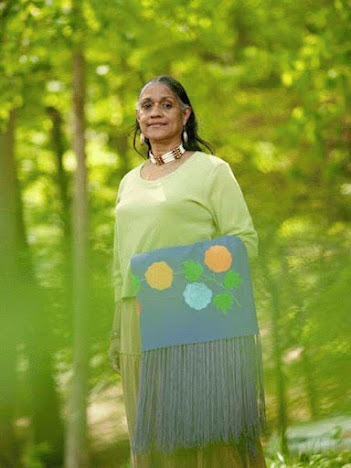


Washingtonian Native wisdom keeper and elder, 
Rose Powhatan, a Pamunkey and Tauxenent
descendant whose American Indian ancestors
were recorded as two of the three Native American 
nations who are indigenous to the Nation's Capital 
and surrounding Metropolitan Area. The third DC
named Algonquian tribe, the Nochoctank, became 
extinct after 1668.


Rose Powhatan giving a Land
Acknowledgement blessing on August 8,
2020 in her DC home in "Attan Akamik,"
the Algonquian name for the Powhatan
Territory on which her NW portion of
Washington, DC was built. The South West 
portion of the city was also included in her 
ancestral area. (See map and video ceremony
below).

In this time of heightened awareness of cultural inclusiveness it is necessary to
honor the First People of the American landscape. However, research and not
speculation must be made about the legitimacy of the tribal claim to the
territory in question.

How is this done? 

Here is one process that was conducted on August 8, 2020 in Washington DC.
The YouTube broadcast ceremony below was for the opening of the over three
hour long celebratory video. The event began with two Native American Diné/
Pamunkey boys and their Pamunkey/Tauxenent nali (grandmother) giving a
blessing for the Sankofa Foundation’s commemoration of the 55th Anniversary
of the Voting Rights Act that began in Washington, DC.


A Brief Land Acknowledgment History

A Land Acknowledgement is a formal statement that recognizes and
respects Indigenous Peoples as traditional stewards of this land and the
enduring relationship that exists between Indigenous Peoples and their
traditional territories.

Even in 2020, the continued individual and collective Native American attachment 
to ancestral territory is evidenced by the 1587 Powhatan image below. 

The image was recorded in watercolor by John White on his first English
expedition to the North American coastline on the Chesapeake Bay in July, 1587.

Twenty-six years earlier in 1561, the arriving Spanish visitors had named it Ajacánterm used by the local kidnapped Paquiquineo, later renamed
Don Luís de Velasco. Paquiquineo was taken to Spain and presented at court
to King Philip II. 

Paquiquineo's attachment to his ancestral land was evidenced by his
successful attemp to have the Spanish return him to his homeland in
the Chesapeake Bay, where his people promptly executed his
kidnappers. 

(Click on "Ajacán" to see his story.)


Important Tribal identity: A De Brey etching of a Powhatan Indian
with identifying tribal tattoos. Evidence of strong national affiliation.
Recorded by John White's 1587 watercolors that captured
images of Indigenous Amerindians.


How To Begin

Washington, DC was built on Algonquian territory. Algonquian was the largest
linguistic group of indigenous people in North America. Their ancestral territory
spread from Canada to the Carolinas. in DC, it is believed that they have been
here for over 12,000 years. Their many descendants, survivors of a European
introduced pandemic, enslavement/export and murder, are still here.
  

THE SEQUENCE:

1. Identify. “The first step is identifying the traditional inhabitants of the lands
you're on."
2. Articulate. “Once you've identified the group(s) who should be recognized,
formulate the statement."
3. Deliver. “Offer your acknowledgment as the first element of a welcome to the
next public gathering or event that you host."

The above video clip of indigenous Algonquian Washingtonian Rose Powhatan,
is one example of how this local American Indian ceremony was conducted.

The ceremony was originally intended to be held in front of the Lincoln
Memorial. 

Because of the Corona virus and predicted rain, Rose Powhatan (Pamunkey/
Tauxenent) who was born in Washington DC was asked to conduct
the blessing in her North West yard. Her home is located in the Tauxenent
territory which was the portion of DC within the northern most boundary
of the historic Powhatan Paramountcy. 

In addition, she is a Indigenous elder, wisdom-keeper and Algonquian storyteller
who was born in the Nation’s Capital 74 years ago to a Pamunkey mother and a
Tauxdnent father. Both tribes were recorded as indigenous to the city and its
Metropolitan Area. Her nations are two of the three tribes recorded as indigenous
to the Capital City, within its original boundary stones.

Some of these boundary stones have been preserved below in their original
1791-1792 locations. 

Maps of the Nation's Capital that 
was carved out of Powhatan Algonquian Territory


One of the preserved original boundary stones used as markers to  define 
the original Federal City.


An early map of the Federal City's boundary markers.


Contemporary locations of the Federal City's boundaries.


Washington, DC's location within the Powhatan Paramountcy


NOTES:
A proposal for honoring the Native American who played a pivotal role in Americas founding has been submitted to DC officials. 


Thursday, September 3, 2020

THE FIRST AMERICAN TERRORIST

(By Michael Auld)

Was not a Moorish Muslim. He was a Converso, a Jewish man from Italy's Colombo wool trading family, hiding out as a fake converted Christian during the murderous Spanish Inquisition. Now, this son of Italy is...


Maybe Cristoforo Colombo (above) was psychologically hard on the Terrestrial Paradise's Indios  (a.k.a. the Land of the "Caribbean's" nubile Taíno and Kalinago (a.k.a. Island Carib), or the "New World") because he too was persecuted by his Royal arse hinie, the Spanish Boss of Bosses, Ferdenando II of Arrogant, or was it Aragon? Whose fanatical hate for William Shakespeare's nemesis, Shylock the Jew, people to whom the Spanish Crown owed money. Added to this complex story of greed, murder, is Hemispheric Genocide.

"European colonizers killed so many indigenous Americans that the planet cooled down, a group of researchers concluded,"-- https://www.businessinsider.com/climate-changed-after-europeans-killed-indigenous-americans-2019-2

Well, this soon to be Italian slaver turned pandemic carrier, later saw the naked, nubile Taíno indias laying out, sans bikinis or swimsuits, on their pristine white sanded Beaches Resort (or was it Sandals?) in Jamaica. And thought that he had died and gone to the Terrestrial Paradise, that Spanish clerics also called El Nuevo Mundo. A NEW world, baby!


"Terrestrial Paradise" by Hieronymus Bosch in 1500. The painting is an
idealized European visual interpretation of the Caribbean in which Christopher Columbus had arrived in 1492. This is a white European's wet dream
of the Garden of Eden on Earth, that Columbus had "found'" and described. See any brown skinned 
Taíno Amerindians who thickly populated the Caribbean's Terrestrial Paradise Islands?


America's No. 1 Terrorist 

Landing on the Caribbean's Taíno Bahamian island of Guanahani in 1492, taking a  knee (was he an American basketball playa, or somethin'?). With Toledo steel sword in hand, backed up by his pandemic-infected possy, ready to rape, (as his friend Cuneo did in 1493 off the coast of Ay Ay, a.k.a. St. Croix), kill, maim, and enslave the Indigenous People of the Caribbean, and dabble in Amerindian prostitution.


The painting is of "The Arrival" of Cristoforo Colombo, a.k.a. Cristobal Colon by his Spanish backers, a.k.a. Christopher Columbus by the Englishand co-opted by the Catholic Church as St. Christopher. And the "Discoverer of the New World" by those self-entitled Europeans, who dismissed Amerindian intelligence (Well, the invaders were ignorant of where they were), in a vast hemisphere that was millennia older that Europe's. (I don't see any ancient pyramids, rubber ball game stone stadiums, ancient planetariums, etc, in Johnny-come-lately-to-World Civilizations Europe!)

This first terrorist is Persona-Non-Grata in the Caribbean Island of Yamayeka (a.k.a. "Jamaica"), where he used the local Taíno humans for target practice and dog meat. [Probably the Taino women wouldn't give a pale ginger-hair, self-identifying "god" the time of day. So, like the Jamaican island's first un-welcomed tourist, he lashed out.]


Columbus with his Spanish Possy landing in Yamayeka (Jamaica) for 
his Monday morning business of carnage, walking and feeding his war dogs 
on what he believed to be dangerous beach bums, on a beautiful Spring day, May 5th, 1494.

Aww, snapt, brown meat! Here the artist depicts  one dog biting off a face, an arm, a neck bone, and a beach bum's bum!
Some hungry pent-up shipboard bitches, huh?

Colombo was also a suspect in the surrounding islands of Cubanakan, Ayiti Bohio & Kiskeya, Boriken, the Lucayas, nearby Mexihco to the western Gulf, and Turtle Island peninsular to the north. 


The Charges

Narrated Charges: "At daybreak on the morning of Monday, May 5th, 1494, Colombo "the Butcher" and his ragtag Spanish henchmen/possy, crashed a beach party of Yamaye Taínos." 


Pre-iPhone simulated Pix of a soldier with a crossbow of Columbus and his men with a weapon used in the first terrorist act in Jamaica, in the Caribbean
Americas

Whereby, let it be known: His accomplices shot and killed with deadly crossbow fire, many fleeing indigenous "Indios" locals. To add insult to injury, the unwashed gang of bearded cutthroats using Toledo steel blades, willy-nilly slashed indiscriminately, cutting off limbs left to right. 

Eyewitness Statements: To further intimidate the victims, the Latin gang landed from their longboat limos, set their war dogs on picnicking, disoriented, screaming children shouting "Atte! Atte!" ("Mother! Mother!"); eyeing single, naked young girls and boys (as premarital nudity was their fashion); and bare-breasted, nagua (private parts dyed cotton pelvic covering); widowed women, were all hogtied and set aside for after work-hours rape at the pub. The filthy Spanish gleefully called these groups "!Diserto!" ("Dessert")

  1. Local mature men, even the old, smoking their cigaros to commune with Yucahu (Supreme Being of the Sea), and snuffing  tabacu bifurcated pipes to converse with the ancestors, were not spared by the rank bearded, hairy-like-a-monkey sailors, intent on jacking up the locals. 
  2. Taíno warriors, known for their deadly archery, who had just returned in their 60-70 war canoas after trying to wave off Colombo's Niña, San Juan and Cardera yachts, were run through by the gleeful Crtstiano marauders who had a sporting contest to see which Crtstiano's finely honed Toledo steel swordsman could split-in-half-with-one-blow, any of the wounded or lamed stragglers. 
  3. Escaped, wounded surviving witnesses reportedly observed the red haired Italian purp, shouting in gibberish, with the aid of a feverish sign language.

"Modda-fukas! Where da gold?"

As he snatched the 14k guanin nose-rings, splitting septum by septum along the kneeling line of the weary canoa rowers. To which some astute victims, turned and pointed with their lips in the direction of Cubanakan, some 90 miles away. To which the Admiral shouted,

"!Hijo de Puta! !Eso es la misma los coñyos en Cuba digen de su isla! !Les tomemos thres dias para pasando entre Cuba y Hiamaka :( :( :(!!!

Translation: "Son of a whore! It is the same thing those pussies in Cuba said about your island! It took us three days (just to go the 90 miles) between Cuba and Jamaica!" 
"Dumb fucks. I need to pay back the asshole Royals!" 

(Since Columbus was a Converso the above line, originally in an unidentified language, was redacted from the records by the Royal Sensor for the Inquisition.) 


Many folks only think of foreign-born terrorists. They are right. Only if you also include Pilgrims and other arriving European "settlers" after their entry into the Terrestrial Paradise, not too far from La California (a mythical land of... Guess what? Half naked Black Amazons whose weapons were made from... Wait for it... sacred GOLD
According to Las Sergas de Esplandián. [The Adventures of Esplandián] a novel written by Garci Rodríguez de Montalvo in the late fifteenth or early sixteenth century.-- Wikipedia 

Cover of the popular novel, written after intelligence was gathered by Father Ramón Pané, a cleric who was sent by Colombo/Colon to live with the island's Taino, on the Caribbean Island of Kiskeya/Ayti Bohio, renamed "Hispaniola" by Colombo. Pané's informants told him about the cautionary epic about the First Shaman, Guahyona ("Our Pride") who took the women away to Matinino (The Island of Women"). Pride left them there and went on to Guanin (the Island of 14k Gold"). The 16th century had no such story before of a Golden Island populated by Amazons. Then came the California Gold Rush and the "Golden State" as Hernán Cortés de Monroy y Pizarro Altamirano, 1st Marquess of the Valley of Oaxaca, Mexico, had envisioned La California's tall mountain range, as described in the above popular novel's story, from his location in Baja California.


Mural of the "Black" Muslim Queen Califia and her Amazons, whose only metal was gold.


However, some other European progeny are homegrown terrorists (described as "Good People") in America. The home-grown terrorist problem is less than 530 years old. Some killers of innocents don't only drop out of the sky on the Pentagon, a field in Pennsylvania or the Twin Towers of the Big Apple, speaking Saudi Arabic. The recent perpetrators are males who grew up on apple pie!

The second act of terrorism in the Americas was, as seen above, on Monday, May 5th, 1494 on the pristine azure water, white sand beach in the North Coast's St. Anns Bay, in Senator Kamala Harris's Jamaica. The first hallowed terrorist was the Italian Mafioso leader Cristoforo Colombo, who had many places (my DC city) named for him.The Spanish possy with whom he hung out knew the Boss of Possys as "esta Judío" ("that Jew") Cristobal Colon. You know him by the Latin alias, Saint Cristopher Columbus. We in the Taíno support community think of him as "the Butcher," Adolph's friend  (the other holocaust perpetrator from Germany?), co-purveyor of a slavery/holocaust, foisted on the Amerindians.


Photo Gallery Of First American Terrorists


Hernan Cortez. "Terrorizes of the Aztec Triple Empire" in 1519

Jamestown, Virginia terrorists to the Algonquian Powhatan Confederacy, arrive in Tidewater, Virginia in 1607.

NOTES

Disclaimer: I and my family, as are millions of people in the Americas, are among the survivors of the American Holocaust. 

This article is a parody that is based on some recorded historic occurrences in 1494, on my homeland island of Jamaica. Upon the arrival of Christopher Columbus in Jamaica, he was rebuffed by the the island's Yamaye Taíno. He retaliated with deadly fire and war dog attacks. His first terrorist attack, occurred the year before in 1493, when he returned to Hispaniola (Ayti Bohio/Kiskeya) where he had left his marooned crew on the beach. His rowdy men disrespected their Taíno hosts by demanding large quantities of more food and women. The nearby kasike Caonabo attacked and killed all 39 Spanish seamen and destroyed their fort La Navidad. Upon Columbus's return with 17 ships of invaders, he killed many Taíno.   


Wednesday, August 19, 2020

Getting to know Kamala’s Jamaica

 © 2020 by Michael Auld

 Dedicated to Kamala, Jamaican descendants, my children and grandchildren


I am a 77 year-old Jamaican National and DC resident with over 57 years of research on my Caribbean Territory. This article was written to honor *the Americas history portion of my fellow Howard University alumna and honored fellow Jamaican descendant, Democratic Vice Presidential nominee, Senator Kamala Devi Harris (CA).


* I don't Use the words "New World" for an ancient hemisphere whose highly advanced civilizations rivaled those of the Eastern Hemisphere.  


Democratic Vice-Preset elect, Senator Kamala Devi Harris with the US, Indian and 
Jamaican heritage flags.

This story is the first to honor the Jamaican immigrant heritage half of America’s first Black/Asian and female Vice Presidential nominee,Kamala Harris, with historic underpinnings. Ancient India we know.

But what about...

OUR JAMAICA?


The island of Jamaica is just the size of Connecticut. It was part of the Northern Caribbean’s Taíno civilization. One of our proud sayings is, “We may be little, but we talawa (tough)!” 

Kamala Harris and I are rooted in a profound history within an ancient, yet underestimated hemisphere. She is also a product of a Western Hemispheric territory which produced phenomenal people and goods that have reshaped the planet, especially after 1492. So much so that in foodstuffs alone, 60% of what humans eat on planet Earth originated in her paternal Americas. Not so inconsequential a gift, this addition to popular culture, also includes not only reggae, but Central American/Taíno chewing gum (from the chicle sap of the naseberry/sapodilla tree, made into “Chiclets”), used to calm the nerves of WWII soldiers.

Jamaica has a history of excelling in sports. So much so that one of its governmental departments is the Ministry of Culture, Gender, Entertainment and Sport.  

Rubber ball History: The Taíno male or female ball player hitting the heavy airborne rubber ball with only the hips, to "keep it alive.". In the Caribbean, the player often wore a beautifully carved stone belt to offset the body's center of gravity. The  batu game's bouncing ball influenced all world team sport games, especially those played with a rubber ballWhen the arriving Spanish first watched the game in the Caribbean, they thought that the latex ball's bounce was caused by witchcraft. Mexico's ancient Olmec Civilization invented rubber and the ball game.The Mexica (Aztec) game was often a life or death event in elaborate stone stadiums where the ball represented the sun's path. The outcome could mean a player's honored death via a messenger to the gods. Gambling was the norm. In Mexico, cities could be gambled away by lords. The Caribbean's games were more social. Vulcanized latex was also used for rain ponchos, waterproof shoes and toys.

Taíno batu stone belt. (The Dominican Republic)


First seen in the Caribbean, one Amerindian civilization, the Olmec ("People of the Rubber") invented latex rubber. As well as its ingenious team sport ballgame that spread around the world via soccer, basketball and all rubber ball games. Other evidence of advanced technological accomplishments was mining in the Americas that began 12,000 years ago in Chile.

Taíno myth of an Island of Women (Matinino) and one of gold (Guanin) unwittingly enriched Europe, influenced the search for El Dorado, the naming of the Amazon and also resulted in the naming of La California; Andean Inca gold mining was dated in use since 2155-1936 BCE) while the Huancavelica Quechua people of Peru mined silver; North American copper was mined since 5000 BCE; other precious minerals (exotic woods and gems) enriched the Spanish Empire while the Venezuelan Pearl Trade (from the Caribbean’s Margarita Island) rivaled that of the old Middle East

Columbus set out for cinnamon, cloves and black pepper spices, intending to circumvent the Turkish blockade, in order to find a passable route to the spices of East Asia. Instead, he encountered the myriad of capsicum peppers (chili, habañero, tame to piping hot), vanilla, and allspice. 

 John Rolfe, Pocahontas’ second husband, imported Caribbean Taíno tobacco that financed America’s Revolutionary War, while Amerindian minerals built governments, cathedrals, universities and economies in foreign colonial homelands.  


There are many Jamaicas!

No! I am not only talking of the people of African descent, the Brown Man, Lebanese, East Indian, Chinese, Sephardi Jew, European (with ancestry from Portugal, Spain, England, Scotland, Ireland or Wales). As seen by our Coat of Arms below, this beloved island of many is not just one thing. Here is an abbreviated list of which I'ii just introduce five more. Overseas Jamaicans affectionately called their beloved island, "Yaad" (meaning "yard"). Upon meeting, two islanders in the USA, picking up on the accent, may colloquially ask, "You a Yaadie?" 


Jamaica and Religion 

The island is a deeply religious country whose laws established the freedom of religion and prohibit religious discrimination. Most visible are the Rastafarians (a Black empowerment religious group whose "sect" began in the mountains in the 1930s and considered an Indigenous group in the island), who, before Bob Marley were originally deeply ostracized. In 2015 the Jamaican government had to take steps to make amends to Rastas for endemic discrimination, and persecution. It was their dreadlocks, which the police would immediately cut off upon arrest for smoking illegal ganja (marijuana, called the "Weed of Wisdom" by converts) and vociferously proclaiming that God was a living man in the persona of His Majesty, Hialie Selassie 1, "King of Kings, Lord of Lords, Conquering Lion of the Tribe of Judah.(Biblical Ethiopia)." That is, Hailie Selassie, born Lij Tafari Mekennon , is considered as the "reincarnated" Jesus the Christ. Their iconic dreadlocks, later popularized worldwide via Bob Marley's poetic reggae songs, also became an international icon of Black pride.   

The breakdown of religion in the island is: 64.8% Protestant, 2.2% Roman Catholic,1.9% Rastafarian, 21.3% Unaffiliated, and 8.8% other. This "other" category includes 29,026 Rastafarians, 5,000 Muslims, approximately 200 Jews, 3,000 Buddhists, and 1,453 Hindus (and Sikhism). One of my sister-in-laws is a Jamaican Indian. Her three children are "half Indian", as Jamaicans would quantify people by percentages. (1/2 or 1/4 Chinese, Indian, Syrian, etc.)  As a child, I watched Hindu processions with colorful religious liters being carried down to and floated out to sea; ate Indian curry goat & roti prepared without salt by Indian neighbors.  Kamala would fit in.

Pocomania and Other Beliefs: 

Real Ghosts and Mysterious Experiences

Pocomania, also called Revivalism is 200 years old and has African spiritual beliefs. You'll see bible-thumping dancing revival meetings on some street corners at night.  

Mayal “is an Afro-Jamaican spirituality that developed creolization of African religion during the period of enslavement” (Wikipedia). It is considered the positive opposite to Obeah, the connection of spirits with humans as an African offshoot that uses potions and libations. Say if you want a love potion, you go to an Obeah-man

Obeah is Jamaica’s version of Haiti’s Voodoo while Mayal is similar to Cuban SanteriaWe don’t have Haiti’s real-life zombies (a proven method of using potions that include the puffer fish's venomous flesh to place a "perpetrator" into suspended animation, have a funeral, then clandestinely retrieve the "body", that can then be used as a slave-like captive). But, we in Jamaica believe in ghosts that come to you in dreams to give advice or medicinal remedies by “dreaming to you,” as my maternal grandmother related about dream sessions with her late dispenser (pharmacist) husband during her high blood pressure bouts.


Ghosts and Spirit Manifestations

We won't talk here about Annie Palmer, the young White Witch of Rose Hall an immigrant from Haiti who practiced voodoo,  murdered her English Jamaican husband and had enslaved lovers and who was killed by one of them (whose haunted plantation mansion was bought and restored by the Rockefeller family). Neither will I speak of the Elizabeth Barrett Browning Jamaican family estate (composer of the sonnet that reads "How do I Love thee? Let me count the ways."). Or the homes of James Bond's creator, Ian Fleming; or country singer, Johnny Cash whose home is next to the golf course where Annie Palmer from her Rose Hall estate often bathed in an attached waterfall.  

  • · The "Rolling Calf” is a malevolent spirit usually encountered by lone drunkards returning home at night after a bout of rum-drinking. He is in the shape of a ferocious red-eyed fire-breathing angry bull. Your only witness? A few generations ago, your spooked horse would see him too, then throw you to the ground and bolt off!
  • ·       “River Mumma” (river mother) is a seductive Mermaid. At first beautiful, the river mermaid is seen sitting on a riverbank, slowly arranging her long black hair with a golden comb. If you look at her, she’ll entice and mesmerize you, capturing your gaze. Then murderously pull you down into her underwater deep-hole lair.
  • ·       The solid Golden Table is a piece of furniture that on occasion, floats up out of the river's deep-hole, only to drag down any fool that tries to retrieve it.
  • ·      The Spanish Jar is a large ceramic pot, used by the early Iberian invaders to cool drinking water in the tropics. Filled with gold coins and hidden by 1655 fleeing Jamaican Spaniards to Cuba from the island’s Runaway Bay. The British armada had failed to capture the strongly fortified Hispaniola next door. As part of the English's Western Design to blow up Spain's successes in the Americas, they were thwarted from their attempt. Admiral William Penn and General Robert Venerables decided to go back home to Oliver Cromwell by taking the less protected Jamaica (used for cattle and horse farming for the expanded invasion of the continental Americas since the Spanish found little gold in Jamaica). The Spanish pot of gold often caused tragedy for the unlucky finder.
  • ·      
  • 18th century woodcut of the notorious Three Finger Jack..
  •  The highwayman, Three Fingered Jack a.k.a. Jack Mansong, was a real right hand, three digit person. The leader of escaped enslaved runaways with an English bounty on his head. Jack and his lieutenants were hunted down. He was killed by a party of Maroon bounty hunters in 1781, one of his lieutenants was captured and jailed while the other escaped. After the Jamaican Maroons signed their Treaties of 1739 and 1740 with the British (the First in the Americas to gain independence), they agreed to no longer accept runaways from the sugarcane plantations, but help to capture escapees. (For a more click on https://obeahhistories.org/three-fingered-jack/

However, we must start at the beginning...

Above: Jamaica's Coat of Arms. Originally composed in 1661 by William Sancrof the 
Archbishop of Canterbury (remastered in 1962 for the island's Independence) four years before the English invaded and seized 
Spanish Jamaica. It is composed of two Yamaye Taíno, a woman with a basket of local 
foods 
and a 
bowman (the Yamaye were considered excellent archers). They stand on 
Jamaica's 
1962 independence motto beside a cross with five endemic pineapples. 
On top of the 
shield is an English hereditary symbol capped by an endemic Jamaican crocodile.  

The Indigenous: The island of Yamayeka (Jamaica) was in its Pristine Era 6,000 years ago when it was most beautiful. Hunter-gathering Pre-Taíno Amerindians easily came across the sea by watercraft originating from Florida, Belize and Venezuela over the Caribbean Sea, via cays/cayo (a Taíno origin word). The sea level was much lower then because of its capture in both poles. In our island, the seafaring agriculturalist Yamaye (yam-á-yae) Taíno originated as river-going people from the Orinoco River Basin in Venezuela, turned seafarers, arriving in the northern Caribbean at the time of Christ. There they developed a sophisticated civilization with a stratified society of rulers, advisers, priests, nobles and an underclass. With the island of  Kiskeya/Ayti Bohio (the D.R. and Haiti) as the center of their civilization, they divided the larger islands into cacigazos (hereditary chiefdom), governed by female and male cacike, sub-cacikes, and their Ni-Taíno advisers. History was recorded via areitos, a dance and song historical recital. It is from these people that the world got many foodstuff, technologies and words, many of which originated on mainland South and Central America. Among them are huracan/hurricane, the anona (pineapple), batata (sweet potato), yuca (cassava/manioc/tapioca), varieties of beans, aji (varieties of peppers), allspice (pimento), pumpkin, tabacu (tobacco), barbecoa (barbecue/jerk), hamaka (hammock), and much more.

  1.   The North Coast of the highly populated Yamayeka (Jamaica) was the first in the island to encounter European outsiders. In 1494 Christopher Columbus also became the first rebuffed tourist on the island's North Coast. There 
    where many houses and a multitude of Taino had gathered on the beach.  Warriors shot arrows at his ships from 60 to 70 war canoas (a Taino source word for “canoe”). Columbus responded by killing a number of Yamaye and sent war dogs on shore to maim the scattering crowd. The North Coast Yamaye diplomstically brought yuca and other provisions to Columbus. The South Coast Yamaye at Bajia de Vaca (Bull Bay, near today's Kingston), were more welcoming after his worm-eaten ship had sank on the North Coast near today's St. Ann's Bay. He is quoted as saying that the cacike of that region was the most astute man that he had met in the Indies.
  2. . The MaroonsCimarones, the root word for Maroons, marooned and Seminole, were Yamaye Taínos who removed themselves away from free labor on Spanish ranches to the high mountains in Jamaica, before the English arrival in 1655. After the English capture of Jamaica from Spain, some Africans (mostly from the Akan speakers in Ghana) who were imported to Jamaica from Ghana's Fort Coromantine to work on English sugar plantations, escaped up into the mountains to join the Cimarrones. These mountain Yamaye incorporated the escapees into the fold, and taught them how to survive in an alien land. The result? World famous “jerk” was the local spicy Taíno barbecoa renamed from a Mayan word for drying meat. (also related to “jerky”). The Maroons, who twice fought the English to a standstill, were the first in the Americas, before the US, to win independence from the British crown. (The photographs above are descendants of Maroons who ran away from enslavement to form their own communities, four of which remain in Jamaica today. The catch was, in the treaty with the English, Maroons could no longer accept runaways, but help England to hunt down runaways and scalawags, put down insurrections and help to defend the island from Spain and France). The four Maroon settlements are Accompong Town, Moore Town, Charles Town and Scott's Hall. 
  3. ANANSI, Our Spider-Man

  1. Anansi the folkloric Spider-Man from the Ashanti of Ghana. He is a Jamaican icon. (See http://anansistories.com/)  


PIRATES, BUCCANEERS & PRIVATEERS

Here in Jamaica lived and died the Buccaneer, pirate and privateer, Welshman Captain Sir Henry Morgan, Lieutenant Governor of Jamaica. Buccaneers started out as fired French woodcutters in Hispaniola who moved to an offshore island to make a living from selling barbecued meets to passing ships. The meat was smoked on a boucan. Then these bucaneers began to rob their customers and sailed off into the Caribbean Sea as thieving and pillaging scalawags. They, like the pirates were punished when caught. Some were hung. Pirates were buccaneers by another name. Some privateers, who were initially employed by the British Crown, turned to piracy. This was Captain Morgan’s story. Sanctioned by the Crown, he used Jamaica as a base to sack rich Panama City of its silver and treasures. Returning to bawdy Port Royal on Jamaica’s South Coast peninsular, he was knighted and rewarded for harassing the Spanish and given the title of Lieutenant Governor of the island. His silver drinking cup is a part of a surviving church in Port Royal, a survivor of the 1692 earthquake that sank most of the town into the sea. 

AnecdoteAn informant at the Port Royal church that housed Captain Morgan's silver tankard, with a whistle on the top of its handle, said, "The whistle he would blow when he was too drunk to order it refilled with brew. He would stumble out into the street from the pub and challenge a passerby to drink with him. If the victim refused, Morgan would threaten to shoot him."

5. Along with jerk, famous dreadlocks, Rastafarians, Marcus Garvey and Bob Marley’s revolutionary reggae, Jamaicans took the world by storm. Marcus Garvey originated the Black Power flag and Rastafarians, gave us the name dreadlocks. Although found in Ancient Egypt, worn by Native American, Asian and African holy men, dreads particularly replicate the lion’s main  (Hailie Selassie’s “Lion of Judah”) and represented the Biblical Samson’s strength. (See http://yamaye-mike.blogspot.com/2020/06/black-international-lives.html)


Marcus Mosiah Garvey, August 17, 1887- June 10, 1940,  founder of the Universal 
Negro Improvement Association UNIA) and designed the red, black and green flag 
below. This flag was adopted by the Black Nationalist Movement in the 1960s,


Marcus Garvey's UNIA and the America's Black Power and Black Nationalist flag.


Robert (Bob) Nesta Marley the iconic international artist and Rasta man 
who also popularized Dreadlocks.

ENDORSEMENT

Did I mention world-class Blue Mountain coffee or rum? Jamaica is much more. I recommend a visit to Jamaica first. 

In the age of the Corona virus, relocate your tele-office on a beach; It is just next door.  Then visit fabulous India.