Friday, April 17, 2020

The POWHATAN MUSEUM : A StudioVisit-1

Catalog photo with wall sculpture, "Olokun," for the Faculty Exhibition, 
Department of Art, College of Fine Arts, Howard University (1981).

© 2020 by Michael Auld

Sitting in my studio multitasking.

 This current pandemic has presented an opportunity to reflect on a *1492 holocaust that began to take many lives of the people in my Caribbean homeland. We are the survivors of that world-altering event. 

So was my wife's mainland Amerindian family. 

I married into a very large Native American descended family indigenous to the Nation’s Capital, Virginia, Maryland, North Carolina and Nantucket Island. They are from long-distance travelers from both the Powhatan Confederacy (known as a Native kingdom by the 17th century English, and Princess Pocahontas' people), as well as the Wampanoag traditional whalers of Massachusetts, called "People of the First Light" because of their easternmost location off the coast of the North American continent.  The family includes over 30-odd… and counting... Accomplished artistic souls. Their talents are arts law and art therapy to music; visual, medical and performing arts; writers of books and TV series; to acting as Native extras in documentary and blockbuster productions. Our son played a "Zone One warrior" in the "New World" movie (seen pointing at Captain John Smith's arriving ship in the first scene). While his mom played a clan mother (next to Colin Farrell) in that motion picture, and in the HBO miniseries, "John Adams." She acted as the wailing Natik (Wampanoag) mother of Crispus Attucks, the "first man (bi-racial) to fall" in the American Revolution.


 Since the mid1980s, my works have been based on research in our hemisphere's Indigenous and relocated peoples, their aesthetics, mythologies, spiritual beliefs and resilience. Things I was not taught in my formative years. I see my task as one of retrieving and renewing ancient knowledge, then providing contemporary visual interpretations of my findings.


MY ART: Reflecting on our forefathers


My Taíno silkscreen print that represents my philosophy as an artist. It is the THE PRIMORDIAL CAVE/WOMB with Deminán Caracacoal, one of the Four Sons "who came from Itiba Ca-hu-baba, THE BLEEDING, ANCIENT ONE" (the FIFTH EARTH MOTHER). The print shows the cesarean birth of the four-fathers or four races of humankind ripped out of the cave of Caciba-jagua, Cave of the **Jagua (genep tree, as Jamaicans call the fruit that was used as a sacred black body and cloth dye).The number "4", like the Circle (of life,) is sacred to many Amerindians. [It also represents the colors of the cardinal "Four Directions," each ascribed a color. Red, the East's life force, = blood and the rising sun; Black, the West's mysterious color, = the sacred night: White = the cold North; Yellow = the South's warm winds.]


IN THE TIME OF THE CORONA VIRUS PANDEMIC

I am thinking of...

"The Land of My Inheritance"
(A term taken from the Taíno Great Flood story that refers to the god Yaya, the Supreme Being, who had gone to his conucos or gardens, "the lands of his inheritance." The story says that behind Yaya's back, Deminan and his three brothers had done a mischief that caused the flood that created the Caribbean Sea or Bagua.)   

Me at three months, (1943) Kingston, Jamaica. 


I was born in the Caribbean. My family name, Auld (as in Auld Lang Syne), comes from the Old Ones, 12th century Old English traders who moved to Perth, Scotland. They probably came under the protection of my mother's Campbell clan. 

As reflected in my work as an artist, it has included elements of the research of my  heritages. To me, art must reflect a continuity of life. For this reason, in my formative years, having been steeped in a British Colonial education with a sole emphasis on my English history, as a tri-racial product of Jamaica, I decided to research my two other neglected spiritual heritages, the African and the Amerindian.  


INTRODUCTORY VIDEO


SPIRITUAL BELIEFS AS ART: THE TAÍNO


MY AFRICAN PERIOD: 1965-Now


Stories from my childhood and told to children in adulthood. My two dolls, "Anansesem" (AnansiStories) a published folkloric comic strip (1971-1976), books "How Anansi Came to the Americas from Africa,"  part one of the trilogy, "Ticky-Ticky's QUEST," and an anansistories.com website.


"Olokun " the Yoruba God of the Waters, metal, 1980, is from the 
image of a Benin bronze figure with mud-fish legs, a crocodile scepter
and a sword. Olokun is part of a series of my Objects of Power along 
with Ogun, God of Metallurgy, and the father god, Obatala.


"Guardian Spirit: Marcus Garvey," welded steel, etched, inlaid and painted Plexiglass that is based on Ethiopian Guardian Angels. Part of a trilogy of a sculptural installation done in the 1980s to guard the children of Soweto, South Africa when they were being killed for protesting Apartheid.
"GUARDIAN SPIRITS" with details. A triptych installation often portrayed in a circle. 

L-R: Harriet Tubman (American freedom fighter, "Conductor" of the Underground Railroad); Isis or Ast (Egyptian Mother Goddess), Marcus Garvey (Jamaican-born political activist, founder of the United Negro Improvement Association and African Communities League). When exhibited at Fondo del Sol, Museo Multicultural in DC, someone placed coins at the feet of the installation. 

MY TAÍNO PERIOD: Mid 1980s-Now


"Iguana-Boina" is a transitional piece in welded steel, carved and inlaid 
Plexiglass (9' X 4'). The Iguana/Sun is being overtaken by the Black Rain-cloud 
Serpent, the Boina. This was my move to the use of natural materials for the 
sake of Amerindian aesthetics. Photographed against the back wall of Duke Ellington School of the Arts, where it was made.


"He Who Does Not Blink", a silkscreen print (December, 2013) is an interpretation of the Taíno Origin Story of Mácacael (see above) and the Iguana-Boina, the concept of the SOURCE OF LIFE. The serrated back of the iguana represented the sun’s rays of a lizard who absorbs warmth via the sun’s ultraviolet rays (shown here as Iguana-el, Son of the Sun}, and the Boina (Boina-el, Son of the Dark Raincloud serpent), are part of the belief system of the seafaring agriculturalists known collectively as the Taíno. 


"Quic: Homage to the Olmec, People of Rubber." Four views of a mixed media sculpture
(Latex rubber, wood, stone, conch, crocodile teeth, feathers and paint). The symbolism within this life-sized sculpture is to honor the ingenuity and strength of the ancient Olmec civilization of Central Mexico. They invented rubber by vulcanizing the sap of the rubber tree to create the world's first team sport and rubber ball games now enjoyed worldwide in the form of football, soccer, basket and volleyball, tennis, as well as latex gloves, tires and toys.

"Itiba Cahubabathe Fifth Earth Mother giving birth to the Four-Fathers of humankind. Materials: Wood, vines, ceramic, and paint. 1990.


Installation of "Mucaro Behike" or OWL SHAMAN, shape-shifting into Mácacael, HE OF THE EYES THAT DO NOT BLINK, watchman over the Taíno  .1991. Materials: Wood, macaw feathers.  higuera or calabash tree gourd markka and containers with sacred tobacco,  mahisi (maize),  yuca (cassava), aji (chili peppers), beans and other indigenous foods that entered world cuisines after 1492.


"Guahayona in his Canoa," Fondo del Sol Museo Multicultural, Washington, DC exhibit, 2014. Fondo's Director Marc Zuver and author of "The Indian Chronicles," Dr. José Barreiro (Cuban Taíno) at the National Museum of the American Indian in Washington, DC, and his Native American wife (back turned, viewing the above Mucaro Behike installation ). Photo by one of the family's professional photographers, Camille Pasley.


***My above silkscreen print's interpretation of the continuation of the Travels of Guahayona. It is my theory of the influence on Spain by the Taino's Guahayona epic on the naming of La California by Hernan Cortez. Cortez read the most popular 16th Century novel by a Spaniard named Garci Oronez de Montalvo, published in Seville in 1510. 


CURRENT SERIES: 

**Jobo Tree Spirits


"Tree Mother," Wall sculpture of a work in progress of a new series that is a part of the Jobo and sacred Jagua people, turned into trees by the sun at the Creation.
Materials: Cigar tree (Catalpa, native to the eastern United States), wisteria vines and shell.
Research rationale: This will be, in the tradition of the Taíno, a cemi (zemi) made to honor the trees that were cut down to make way for a building.


Tree Mother's breast, carving in progress for the above wall sculpture.


Finished wall sculpture.

NOTES:

  1. * The 1492 European introduced pandemic initiated the Amerindian Holocaust that brought smallpox, measles and other viruses, "within the first 100-150 years" and beyond, "regions [in the Americas],  "lost 80 percent of populations."--Washington Post  "The Cornovirus Pandemic", April 12, 2020.   Another report stated that the result of that pandemic's decimation of peoples in the Americas caused a cooling of the earth.
  2. **Jagua (haguais a sacred tree from some of the First People in the primordial Caciba (cave) that housed the Taíno and related people. In the Creation story, people were cautioned not to go out into the sunlight, some went out to fish were caught by Guey, the sun, and turned into Jobos (hobos) trees, who are our relatives. 
  3. *** The name of the book was "the 'Exploits of Esplandian,' and it was written as a sequel to the popular Portuguese poem, 'Amadis de Guala'." (Wanda Sabir, San Francisco Bay View). In 1519, after Hernan Cortez had defeated the Mexica (Aztec) Triple Alliance, he went to Baja California where he saw the tall mountains in the distance. He surmised that this was the fabled Island of La California, the abode of Queen Califia, Amazon leader whose only metal was the gold with which they made their weapons. In the novel, La California was located next to the "Terrestrial Paradise," the Spanish term for the Caribbean. Soon after arriving in Kiskeya/Ayti Bohio (Hispaniola) Christopher Columbus had sent Father Ramón Pané to live among the Kiskeya Taíno, who were rebelling against the Spanish for mistreatment. Pané's job was to learn their ways and he recorded the unique story about Guahayona's travels to Matinino and Guanin. 
  4. For an article by our arts lawyer son, Alexei (alexeiauld.com) for his story on his bi-racial Wampanoag family member's whaling history... see Alexei's article on  “Finding Out You Are Descended from a Fredo”  https://www.ozy.com/true-and-stories/finding-out-that-youre-descended-from-a-fredo/258276/
  5. Washington Post Review


Tuesday, February 4, 2020

HE WAS BORN FREE

Copyright by Michael Auld
Contributor: Rose Powhatan (Pamunkey/Tauxenent/Wampanoag)

The Wampanoag: Giving Credit

Give credit where it is due.

A courageous man from a family bent on survival in one of America’s most life-taking professions inspirers one’s adventurous imagination. For a man of color during perilous times it seems almost unthinkable that he would excel and prosper in a dangerous profession. Enslavement was highly possible, and one could easily be killed on the job, but Captain Absalom Boston never backed down from a challenge.

He never lost a man at sea. And if that wasn’t astounding, the odds were against surviving during the backgrounds of an ongoing Amerindian Holocaust and African enslavement. A descendant of both world-disrupting calamities, he prospered. Upon his retirement from the sea, he became a community leader and an abolitionist, who successfully won equal rights to education for all of Nantucket’s children.

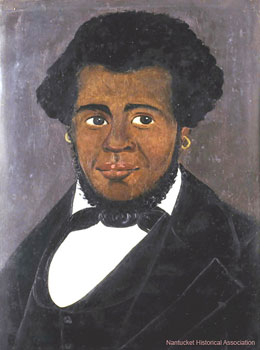
Captain Absalom Boston

Above: Oil Portrait of Absalom Boston, Whaling Museum, Nantucket, Massachusetts. 

Absalom Boston was born free, the son of an African-American father (Seneca Boston) and a Wampanoag mother (Thankful Micah, named "Thankful" because she was the surviving child of the European introduced pandemic that had plagued the Americas beginning in 1492). His mother’s family counted whalers among them, and followed the traditions of his family by captaining a whaleship with an all colored crew.

In Massachusetts, as elsewhere, it was not uncommon to marry into Native communities. Both Crispus Attuks (The “First To Fall” in the American Revolution) and, Wampanoag/African abolitionist Captain Paul Cuffee also left their mark on contributing to America’s founding history. According to their mother’s matrilineal tradition, Absalom Boston, Crispus Attucks and Paul Cuffee were Wampanoag. However, in today’s debunked racial construct, they would only be classified as “Black.”

Absalom became famous by way of an indigenous whaling tradition taught to both arriving Englishmen and Africans in Massachusetts after the first encounter on December 8, 1620. This date was thirteen years after Captain John Smith had arrived further south to meet the eleven-year-old Pocahontas at Jamestown, Virginia.

The source of Absolom's riches was a similar commodity that makes some oligarchs rich today, oil from decayed organic matter. His money came from the dangers of hunting whales and cooking down its fat blubber in the style of his mother’s Native people. Wampanoags hunted whales, for food and byproducts while the Eskimo or Inuit hunted seals. Then, before crude oil from dead dinosaurs was tapped, “the [whale] oil could serve in the manufacture of soap, leather, and cosmetics. Whale oil was used in candles as wax, and in oil lamps as fuel.”

Like most Indigenous subsistence practices, whaling was survival food to these people of the First Sun, as they were called because of their geographic location. Whales were to them what the buffalo was to the people of the Plains and the deer was to indigenous populations of the Eastern Woodlands. With the arrival of Europeans, similar Amerindian commodities were hunted into near extinction. However, not yet in Absolom Boston’s time.

Wampanoag hunters towed home the leviathan by canoes: Absolom built and designed factory-like ships that went deeper into the Atlantic Ocean.


“Inshore whaling was hunting whales close to shore in small boats with harpoons made with sticks, stones, and bones. The Wampanoag thought of whales as gifts from the [Creator] as whales provided them with food, bones for tools, and other survival needs.” Specifically, sperm whale oil burned cleaner and brighter while it was also a better lubricant.


Whaleships 

Were floating factories, designed and built in shipyards also owned by people of color, some with mixed ancestry. Absalom’s crew manufactured aboard ship bringing home 70 barrels of whale oil at one time. His mother’s tradition was that women carved up the dark red protein, fatty blubber was boiled down for a multipurpose oil from lamp fuel to skincare and more. Whalebone was turned into useful implements, similar to today’s crude oil-derived plastic. As seen in the ads below, these later commodities were from his mother’s tradition.

Hunting a gigantic mammal from a smaller boat was a deadly task. The process of being dragged by a harpooned whale was later called “Nantucket sleigh rides.”
This event was named for the birthplace of the New England whaling industry.


Nantucket Wampanoag Lineage

Although members of the Boston family no longer reside on Nantucket they continue to live in Massachusetts and other states today. After the whaling industry gave way to kerosene oil, Absalom Boston’s descendants and extended family members moved away. They excelled in other accomplished professions. Whaling employed many entrepreneurial skills, not just multi-ethnic harpooners but also accountants, merchants, and other professions that were needed in the Industry.
Above: The late news photographer, Bernie Boston (Tauxenent/Wampanoag) of DC/VA with his Pulitzer nominated Vietnam era iconic photo (below) "Flower Power." He captured a war protester placing a daisy in a National Guardsman's gun barrel.


The tradition of intermarriage with Native women continued with each successive Boston generation. Initially arriving in the seaport town of Annapolis, Maryland, the line continued into Northern Virginia’s City of Alexandria, Washington DC's Native Tauxenent families. Here, they have continued to make their mark.

The 1800s Whaling Industry’s Byproducts 

From oil to soap, the advertised products speak for themselves. Although whale oil was replaced “whale oil is still being used to lubricate spacecraft such as the Hubble space telescope and the Voyager space probe.”—Wikipedia


NOTES


  1. The big money was in dangerous whale hunting on the unpredictable high seas. Although the whaling industry originated in Massachusetts, hunting moved to the Pacific. Moby-Dick by Herman Melville was located in Polynesia as part of the transferred South Sea industry.
  2. For an article on his Boston family's fortune, read an autobiographical story by Alexei Boston Auld (alexeiauld.com) in Ozy.Com: “Finding Out You Are Descended from a Fredo” https://www.ozy.com/true-and-stories/finding-out-that-youre-descended-from-a-fredo/258276/

Friday, December 27, 2019

WASHINGTON DC's ONLY REAL ROYALS?

ROYALTY and IMPEACHMENT

By Michael Auld 

 During Donald Trumps impeachment his critics said that he wanted to be a king. However, this pedigree is usually decreed by birth. True American Royalty lay elsewhere. 

If the 17th Century English were right, the most widely known royal Washingtonian was our Princess Matoaka a.k.a. Pocahontas. 

The territory that came under her father’s governance included a major portion of our contemporary District of Columbia. And, Capitol Hill was his “favorite place to caucus.”. 

(See DC map below).
A print titled, “Pocahontas Unmasked” by Rose Powhatan (Pamunkey/Tauxenent) one of  her distant maternal cousins. This is a rendering of the DC artist's reinterpretation of an image of Pocahontas as a tattooed Native American young woman of color, (from John White's 1585 watercolors based on the Amerindian phenotype) of indigenous Virginian women. The print challenges an English artist's (Simon de Passe) interpretation of her as an acceptable, "proper" white English princess of the times.

In life and in death she was, and is still America's most venerated princess. Accepted at Court by British royalty as "Potentiss Prince Powhatani Imp Virginiae", her second husband (via a bigamous marriage), the commoner John Rolfe, in 1616, was scolded by the Queen Anne of Denmark, (James of England's wife) for having the audacity to marry royalty.

To underscore her pedigree, she was first portrayed by the English as a royal person. Then, in the US Capitol's Rotunda...


Above: Giant 12'x18' painting by John Gadsby Chapman (1839) of the Baptism of Pocahontas, daughter of "the influential Algonkian chief Powhatan." Here she is depicted as a woman of color. It is located in DC's Capitol Rotunda. "The Heart of America."


Pocahontas is almost deified in many ways in contemporary American culture. Examples are Disney's Pocahontas, later in Terrence Malick's The New World epic, in numerous publications, and documentaries.


The New World movie was shot next to the Chickahominy nation’s River in Charles  City, Virginia near Richmond. Many of the extras were from the historic Powhatan Confederacy. Rose Powhatan (Pamunkey/Tauxenent) portrayed a clan mother while her youngest son, Kiros played a Zone One Warrior. He is in the opening scene as the warrior pointing at Captain John Smith’s arriving ship.


POCAHONTAS'  TRIBE

Seal of the Pamunkey (“Place of the Sweat”). This was the location of an Algonquian temple center and the home village of Pocahontas. Another Pamunkey village site was also located in both the District of Columbia and *"Pomunkey," Maryland'


Pocahontas, like her famous father, the werowance (leader) Wahunsenacawh, the second Dreamer (or “Powhatan”) were Pamunkey, a leading part of Native America’s only encountered 32-34 member empire under the governance of one man. Their nation is located in King William County, Virginia and there are currently numerous surviving descendants. This is the oldest reservation in North America. The reservation was established in 1658 after the last Powhatan Wars of attempted foreign expulsion. One could call the Powhatan conflicts with the English, the first "Wars of Homeland Security."


However, after the American Revolution, this First Daughter was relegated to just an idealized ancestor of many European Americans.

Pocahontas is so popular that today there are many Americans who claim descent from her. Those of note are called The First Families of Virginia." This presumptuous designation that typically in America, disqualifies millions of Native Americans whose first Inhabitants have still been here for millennia.   

“People who claim to be descendants of Pocahontas can be found in every state and number about 100,000. Distinguished genealogists have conducted searches in the few remaining records in several "burned" counties, which provide some proofs of Bolling family ties to Powhatan.” [President Taft’s wife Ann Bolling, of Bolling Air Force Base in Maryland, claimed descent from Pocahontas]  
 "POCAHONTAS IS A POPULAR GRANDMOTHER TO CLAIM”-Virginia Rollins, April 1, 2006. 
https://www.google.com/amp/s/www.dailypress.com/news/dp-xpm-20060401-2006-04-01-0604010024-story,amp.html

WHO'S YOUR DADDY?

And why does he need recognition?

Oil painting: "The Crowning of Powhatan". by John Gadsby Chapman. In the painting, Pocahontas and her mother sit just behind Powhatan.

Powhatan II or Wahunsenacawh was responsible for allowing the first successful English settlement to exist in North America. Yet, its successor, the United States of America has no DC monument to him. Powhatan II has, therefore, become the most disrespected leader in American history.


Although our current president treats his office like a potentate, he was not the first to toy with the concept of imposing royalty. Also, George Washington was not the first American to be offered kingship. America's first territorial "Washingtonian" king was Pocahontas' daddy.
As seen in the above painting, crowned a king by the English, Powhatan II, Princess Pocahontas’ father, governed over an extensive Native American territory that was demoted to a “Chiefdom” or a “Confederacy”. Yet its most famous daughter’s title as a princess was never dropped.

Sothe more popularly known DC Indians are fake. Native Americans call them Wana-bees. They derogatorily call themselves the Redskins, considered  "offensive terms for Native Americans." (WorldNet Dictionary).   

Why is she a Washingtonian? 

Washington, DC, especially Capitol Hill, is located within the boundary of the Powhatan Confederacy whose political capital was Werowocomoco (that comes from the Powhatan weroance, meaning "leader" in English; and komakah-comoco), a "settlement"  located near the north bank of the York River in what is now Gloucester County, Virginia. Since this was "where America began", this location could be said to be America's first capital. To say that America's first capital was a European settlement on indigenous land in Philadelphia, PA, is to totally disrespect current sentiment and ceremonies of Indigenous Land Acknowledgements.

The following below is the genesis of the city that we now call Washington DC. Wahunsennachaw or Powhatan II was momentous, or paramount chief, of Tsenacomoco. This territory was an area larger than ten current American **states, that extended through war and diplomacy, into within Washington, DC proper. It is during these decades-old diplomatic sessions that Powhatan II's caucuses (Powhatan Algonquian for "councilor) met on Capitol Hill by the Tiber or Goose Creek (now under Constitution Avenue).

The following are different incarnations of Washington, DC: 
Powhatan Territorial Map http://www.powhatanmuseum.com/Powhatan_Map.html
  1. Both the original Federal City’s boundary stones in Virginia and Washington DC and the current border were carved out of the Algonquian territory whose first recorded area was named Tsenacomoco a.k.a. Attan Akamik (“Our Fertile Country”).
  2. The northern portion of Powhatan's territorial Kingdom/Confederacy/Chiefdom (Date of territorial acquisition by Wahunsenachaw unknown).
  3. Named in 1607, the Virginia Territory by the arriving representatives of the Virginia Company of London.
  4. The American Colony.
  5. The States of Virginia and Maryland.
  6. The Federal City.
  7. Washington City.
  8. The current District of Columbia. It stands to reason that all of the above original territories within which today’s Washington D.C. now sits owes allegiance to the indigenous Powhatan Confederacy and its descended tribal governments and their survivors. Many of these Indigenous descendants have continued to live, work and be educated in Washington, DC. Their leaders under Cockacoeske signed the final 1677 Treaty of Middle Plantation on their behalf.

NOTES:

*Pomonkey: n,17th Century English interpretation. Maryland name for the Pamunkey (Pá-mung-key) tribe of Native Americans that lived in the MD/DC Metropolitan Area. This second recorded Pamunkey location meant that this was an extension of their main town of the leading tribe in the Powhatan Confederacy and qualifies as their original territory of Attan Akamik ("Our Fertile Country"). At the time of English contact in Jamestown, Powhatan II, then in his 60s, was expanding his territory northwards. This was the second Pamunkey settlement located in Charles County in Southern Maryland (and South Washington, DC) that later became a part of the federal city of Washington City, with its first mayor, Robert Brent   

English chronicler, William Strachey of the Virginia Company wrote that Powhatan II had over 100 wives, many of whom, and their first child, were treated as political alliances of nations within his empire. (E.g. Taux [Little] Powhatan of the Tauxenen is possibly an example of this Algonquian alliance). Princess Pocahontas was one of these offsprings who came from today's Pamunkey Reservation.

The Brent family owned much of the land from before the American Revolutionary War, asserting their claims after Giles Brent married princess Mary Kittamaquund in the 17th century. The jury is still out as to whether Mary and her father, Kitttamukuund were Pomonkey/Pamunkey or Piscataway as other writers claim. The current Charles County in Southern Maryland where Pomonkey is located was claimed, as seen above, via the Brent family’s marriage to 11-year-old Mary. Additionally, the John Smith map of 1608 confirmed that this was the location of the Pamunkey people who were the leading members of the powerful Powhatan Confederacy.  ("Mary" was similar to the baptized Christian name, "Rebecca," given to Pocahontas during her own baptism in Tidewater Virginia). Mary's father Kittamaquund was, like most of the Algonquians near or within the vast Powhatan Territory, were minor "kings" to the early English. They did not have the same clout as Wahunsennachaw whose father, the first Powhatan, had organized the first eight of his son's 32-344 nation empire.   

Robert Brent (1764-1819) became the first mayor of Washington City. (and freed his slaves in his will). The fact that Mary Kittamaquund was a princess married to an Englishman who inherited his large track of land from his wife's people, was in keeping with the English practice in the Virginia Territory of marrying Indian women to inherit Native American property.

** Shown to be larger than the ten contemporary states of Connecticut [5,543.33 sq. mi.], Delaware [2,489.27 sq. mi.], Hawaii [10,930.98 sq. mi.], Maryland [12,406.68 sq. mi.],
Massachusetts [10,554.57 sq. mi.], New Hampshire [9,349.94 sq. mi.], New Jersey [8,721.30] sq. mi.], Rhode
Island [1,545.05 sq. mi.], Vermont [9,614.26 sq. mi.], and the District of Columbia [68.34 sq. mi.]. The information about the size of his territory came from Powhatan himself, corroborated by people within his jurisdiction.