Sunday, September 22, 2019

WASHINGTON DC’s INDIGENOUS AMERINDIAN FOLKLORE


© 2019 by Michael Auld 
(With added photo)

Michabo the Great Hare and other tales: 

As told by Rose Powhatan (*Pamunkey/Tauxenent) at two venues.

Kennedy Center's 2019 promo photo of Rose Powhatan (Tauxenent/Pamunkey) in her traditional Algonquian buckskin dress, telling the "Michabo the Hare Story," fire engraved on the shaft of her Powhatan totem. From a set of photographs promoting the new REACH Building that was constructed in her father's ancestral Washington, DC's Native American Tauxenent Territory, next to the Powhatan Confederacy's Cohonkarutan ("River of the Geese") later called the "Potomac" River by the English.


Rose Powhatan carrying on a tradition estimated to be over 12,000 years old. The epic is about a giant hare called Michabo. He had a priestly following by Algonquian speakers, the largest linguistic Indigenous group in North America. He was known throughout their land from Canada to the Carolinas. His time-honored tales live on through Rose’s storytelling in her city of birth, her father’s Tauxenent territory in N.W. Washington, D.C. This city is a part of a larger land area that also includes Northern Virginia, where some of her Boston family grew up hunting and fishing with their Pamunkey (Mills) family. Algonquians married each other within their confederated nations. Rivers were not boundaries, but highways and food sources.

Here, Rose is standing in front of her fire engraved "Treaty Story" Powhatan Totem. The sculpture is a modern 1982 rendering of a traditional set of totem poles captured in 1585 in watercolors by the English watercolorist, John White. This totem is on loan to the Riverbend Park as part of a Tauxenent installation in the park's Visitors Center. The pictographic story on the shaft of this totem has a tale used on some Pamunkey traditional pots made from the early 1900s.   


Annual Treaty images from Pamunkey pottery
Line 1: 
Each year when the geese fly....Indians.....go on a journey....across the water....to meet with the Governor of Virginia 
Line 2
: There they meet.....and agree....to smoke the pipe of
 peace ...give firs and other game....and remain at peace.
*The Treaty of 1677 was signed with the King of England by Cockacoeske, the Queen of Pamunkey on behalf of those tribes under her leadership and other neighbors of her Powhatan Paramountcy.                                       http://powhatanmuseum.com/Annual_Treaty_Ceremony.html                                

From the time of Powhatan II, Pamunkeys have traveled from Tidewater Virginia, settled outside D.C., in southern Maryland and have been born, lived, been educated, worked and have been buried in the Nation’s Capital. This was, of course, Powhatan II’s favorite Capitol Hill location by the Tiber River, to caucus (from a Powhatan Algonquian word) with surrounding nations. Chroniclers stated that "Powhatan never left his area."

Rose’s stories are a part of D.C.’s Powhatan Confederacy that emanated from her maternal center on the Pamunkey Reservation in King William County, Virginia. This was the “Place of the Sweat” as Pamunkey translates. It was also thought to be their temple center for Wahunsenachaw, publicly known as Powhatan II, father of Pocahontas.


Above: Items from the grave of a shaman in the Great Mound, Hopewell, Ohio. Incidentally, there is also a mound on the Pamunkey Reservation in King William County, Virginia, the oldest reservation in North America. Powhatan II is said to be buried in this mound.


Above: Artist's rendering of an Algonquian priest with a Michabo 
copper headdress.


MICHABO (Mí-chá-bó)
The Great Hare


The Algonquian culture hero was the creator of the world and the impersonation of life. He was reputed to possess not only the power to 
live, but also of creating life in others. He was chief of all the animals 
And in ancient times caused mankind to be born from the dead bodies 
of the first of those who died, thus giving rise to the widespread belief 
among these Amerindians that they had their life force from animals. He impersonated life in an unlimited series of diverse personalities. He was life struggling with many forms of wanting, misfortune, and death that comes 
to the bodies and beings of nature. In his journeying over the earth, he destroyed many ferocious monsters of land and water whose continued existence would have placed in jeopardy the fate of the people.

One of these monsters was the Great-Horned Serpent. The fossil bones of extinct animals occasionally brought to light, are said to be the remains of monsters destroyed by the Great Hare.

“One day, Michabo went hunting with his friends, the wolves. Suddenly, 
water began to rise and covered the Earth. Michabo held on to his 
magic bow to save himself.”

STORY ENDING: "And...That's where women and men came from. The End." 


This Great Flood and human origin story told here on her father’s ancestral Tauxdnent land at the Riverbend Park on September 7, 2019, by Rose Powhatan (Pamunkey/Tauxenent). The story was repeated a couple days later at the other Tauxenent’s Washington, DC territory on which the Kennedy Center sits and had its first ****Land Acknowledgment 
observance.

INDIAN COUNTRY TODAY'S news article on Rose Powhatan at the 8:30 a.m. Private Opening of the Kennedy Center's new REACH Building's Land Acknowledgment observance. She was the primary indigenous Native American representative for the REACH ceremony for the arts building that was constructed on her paternal Tauxenent territory just across from their traditional hunting ground on DC's Roosevelt Island in the Potomac River. 


Incidentally, Roosevelt Island was a source of Tauxenent beaver pelt trade, fishing, and hunting the noisy bird, the "cohonk" (Canadian geese that flocked there yearly in the thousands in Fall, giving the river the raucous name "Cohonkarutan"  or "River of the Geese". Cohonk was also the source of the English words "honk," "honky" and "honky-tonk"). The Tauxenent island seemed to have also given the last remnants of the  Nochoctank survivors a temporary place of refuge in 1668 after they had been driven from the bank of the Anacostia River. The final report of the Algonquian Nochoctank was reported sighting in Detroit, Michigan. 
TOP MAP (area in red): There were two major Algonquian nations in Washington, DC, the Tauxenent (East and 
West of the Potomac River), and the Nochotank who occupied a town on the SE bank of the Anacostia River, and other tribal Algonquian villages within the city proper.  This is the first map of  Washington, DC to show the District of Columbia's Wards approximately within the historic Powhatan Confederacy Territory. (Click on the map to enlarge).

WHERE ARE THE POWHATAN PEOPLE TODAY?

HOW TO IDENTIFY AN INDIGENOUS TRIBAL GROUP?

I have witnessed that research by qualified historians in local Native American history must be consulted before beginning an all-important Land Acknowledgment ceremony. In Washington, DC this task can be daunting since the Nation’s Capital attracts members of many Native groups from around the nation to Federal jobs. Among Native Americans, language or ethnicity can be defining identity markers for the indignity of an Amerindian nation. As it stands today, there are many non-Algonquian pretenders who are now claiming the title of "Washington, DC's Indians." The city, as part of the Eastern Woodlands, was not comprised of the other historic Iroquoian or Siouan competing nations. It was Algonquian and continues to be so defined up until this modern era. DC’s problem is that local Amerindian history is not taught in our schools. This dilemma leaves the city wide open for misinformation to our city's students. Yet, there are many published authoritative authors whose careers have been on the Powhatan Confederacy and its surrounding area. 

As a result of continued tribal sovereignty, it also stands to reason that those extinct Algonquian-speakers tribal villages who were linguistically connected should be represented by the city's surviving Algonquian descendants who have never left their area.


The continuation of cultural practices is important to being indigenous. Rose Powhatan's Washington, DC 
residency, her Algonquian storytelling and the continuation of her ancient Amerindian traditions in her contemporary artworks, qualifies her as an Indigenous Wisdom Keeper.

___________________________________________________________________________________

NOTES:
1.    *The Pamunkey was the leading nation in the historic Powhatan Confederacy, who met with Captain John Smith in 1607. Both it’s leader Powhatan II and his minor daughter, Pocahontas, was Pamunkey whose Reservation in King William County in Virginia is the oldest in the USA. Inheriting eight nations from his father, Powhatan, his 32-34 Algonquian nation “empire” as the English perceived it, was the largest political territory led by one man in North American history. He allowed the USA to come into existence, yet only his daughter is so honored in the Capitol's Rotunda, by a large painting of her baptism. Why has Powhatan II not equally honored in the Nation's Capital? http://www.powhatanmuseum.com
2.    **Attan Akamik = "Our Fertile Country", one of the names for Powhatan II's territory.
3.    ***Pamunkey means "Place of the Sweat", an allusion to the sacred or temple location of the powerful "empire," sometimes called a "confederacy." They are technically the historic progenitors of a major portion of Washington, DC and should be so recognized in all sovereign territory to territory Land Acknowledgements in the Nation's Capital (See DC map above).
4.    ****What is a Land Acknowledgment?
A Land Acknowledgement is a formal statement that recognizes and respects Indigenous Peoples as traditional stewards of this land and the enduring relationship that exists between Indigenous Peoples and their traditional territories.

5. To see first person videos and information on the Land Acknowledgment, go to:  https://usdac.us/nativeland
6. DC Neighborhood map:   https://en.wikipedia.org/wiki/Neighborhoods_in_Washington,_D.C.#/media/File:DC_neighborhoods_map.png

Sunday, June 16, 2019

The Tangled Web

© 2019 by Michael Auld

Tales about the human obsession with spiders and stories about them go back for millennia around the world. The oldest images of these arachnids are in the Americas. Gigantic line images from Nazca in Peru and murals from Teotihuacan in Mexico are testaments to the awe in which spiders have always been held. Lauren Lyn Cidell who has edited "The Tangled Web: An anthology of spider stories" (2018) provides examples of some spider stories in her book published by Lulu Press.

Back and front covers of The Tangled Web


HIGHLIGHT: "Anansi and Brother Death": Michael Auld's story from http://anansistories.com/Bro_Death.html

 ======================================================================

 ANCIENT SPIDERS OF THE AMERICAS

NAZCA SPIDER: Geoglyph that can only be seen from the sky. Southern  Peru.  Aerial photo of  ancient lines in the Nazca Desert created between 500 BC and 500 AD.

SPIDER WOMAN-1: Mural. THE AZTEC “GREAT GODDESS” The Great Goddess of Teotihuacan (or Teotihuacan Spider Woman). She is a proposed goddess of the Precolumbian Teotihuacan civilization (ca. 100 BCE - 700 CE), in what is now Mexico. The mural of the Great Goddess of Teotihuacan from the Tepantitla apartment complex located at Teotihuacan is in the National Museum of Anthropology in Mexico City.
SPIDER WOMAN-2: Another mural of THE AZTEC “GREAT GODDESS”_ Mexico. 

ANANSI THE SPIDER-MAN
Anansi the Spider-man is a folkloric hero originating among the Asanti of Ghana, West Africa. He traveled with the Akan people to the Americas when they were prisoners of war during the enslavement of West Africans via the Slave Trade. His Anansesem (AnansiStories) continue to be told today as morality tales. (See anansistories.com).

The introductory panel of a contemporary unpublished Graphic Anansi Story that begins with an invitation to visit his friend, Peenie Wallie the Firefly.

THREE ANANSI STORY ILLUSTRATIONS: A cautionary HIV tale from a story by Michael Auld as an extension of "Anansi and Brother Death". These are illustrated excerpts from the story on how to avoid AIDS. Here, Anansi falls to the ground after being covered by "Protection", a condom-like substance from as rubber tree in which various characters had taken refuge in an attempt to avoid Drybones, aka "Brother Death". 
STORY CONTINUATION: In this panel Anansi is protected from AIDS.


FINAL PANEL. Moral: The story's end panel that cautions the reader about taking care of Me, Myself, and I & I (or the Rastafarian term for the First Person Singular, "I").


OTHER SPIDERS: 

(1) http://www.anansistories.com/Three_Spiders.html


(2) Above:  Book Illustration of the Cherokee's Grandmother Spider in Michael Auld's "Ticky-Ticky's QUEST: Travel to Turtle Island".


Sunday, May 12, 2019

DC’s Missing Indians

Case of the Disappeared 

The Tauxenent or Dogue and Pamunkey of the Metropolitan Area (or DMV)

Today, Washington, DC still shares in a national issue of  Crimes Against Humanity, the disappeared Indigenous population. America’s history against its indigenous people has continued since the arrival of their English predecessors in 1607. The newly formed Revolutionary Government continued its atrocities against millions of Native Americans. Today, the crimes continue with Disappeared and Murdered Native Women, to its murderous infection of imported pathogens (rats, diseased people and blankets), wars against humans they deemed “savages”, the 1924 Racial Integrity Act of Virginia which was exported to Washington, DC. This last act has contributed to the official disappearances of the city’s Tauxenent off to Dogue, and the Pamunkey descendants.

THE SURVIVORS

 Today, hundreds of descendsnts of Native Americans who have been Indigenous to the DMV for thousands of years have disappeared from the records. Yet newcommers to our city had deemed them disappeared. The main reasons? There is no establishedDistrict of Columbia tribal government. Yet, their descendants are everywhere... just victims of Virginia's importes 1923 Racial Integrity Law (click to read a blog on "Surviving Document Genocide" by Rose Powhatan).

Moving in and out of the city proper for to live, work, or for schooling on all levels, was the norm. Ancestors also worked in local DC stone quarried (one in the National Zoo off Quarry Road, NW) whose stones were used in building DC structures like the interior of the Washington Monument, a Smithsonian building, the eves of the Capitol Rotunda, canals, and even Georgetown's "Exorcist steps".  

Pamunkeys in DC:  (L-R) late Pamunkey Chief Willian (Bill) "Swift Eagle" Miles (stooping). 
Back row: Bill's late wife, Ann Miles; Bill's cousin, DC-born Georgia Mills Boston Jessup (Pamunkey) artist, DCPS School Administrator: Georgia's daughter, DC-born, resident Rose Powhatan  (Tauxenebt/Pamunkey); woman representayive of the Islamic Center of Washington, DC. Bill and Ann visiting from the Pamunkey Reservation, stayed with Georgia in her Maryland home while on an official 1980s tribal business with the Islamic Center who had offered medical care for the reservation.


Photos: (Top) Georgia Mills Boston Jessup (Pamunkey) with her painting, "Rainy Night Downtown", Permanent Collection of National Women in the Arts, Washington, DC.

(Middle) Bernie Boston (Tauxenent Councilman), White House photographer for the LA Times, with his Pulitzer nominated Vietnam Era bhoto "Flower Power".

(Bottom) Back & front cook cover of a novel by Rose Powhatan's son, a Lawyer for the Arts,  podcaster & author, Alexei Auld (Pamumkey/Tauxenent), born and educated in Washington, DC, an Columbia School of Law.

Like many surviving Amerindians one must know the names common to certain tribes, likr Bigay of the Navajo. or Mills/Miles and Cook of the Pamunkey, or Custalow of the Mattaponi Reservation, and more. And Washington, DC is no different. Arriving in DC for university in 1962, I met many Indigenous descendants and became a part of one of these extensiuve families with over 18 siblings with over 29 practitioners in the visual and performing arts. So taken by the arts accomplishments of these related families, I wrote a manuscript titles "29 and Counting", documentinf many members who had acomplished great national, international, and local heights in music, opera, drama, podcaster, author, arts education, the visual arts, biomedical communication, atrs law, and art terapy. 

All were proudly aware of their descent from the Dogue/Tauxenent, Wampanoag, and Pamunkey, the leading nation in the Powhatan Paramouncy with America's oldest reservation in King William County, Virginia, three counties in Southern Maryland (the current township of Pomonkey, MD). The Pamunkey counted Wahunsennachaw, his brother, Opichancanoegh, the War Chief, his niece Cockacoesque (the Queen of Pamunkey & DC), and Pocahontas as tribal members. Their Paramountcy foght thee Anglo-Powhatan Wars of Homeland Security, signing pivotal treaties with the spreading British Empire.

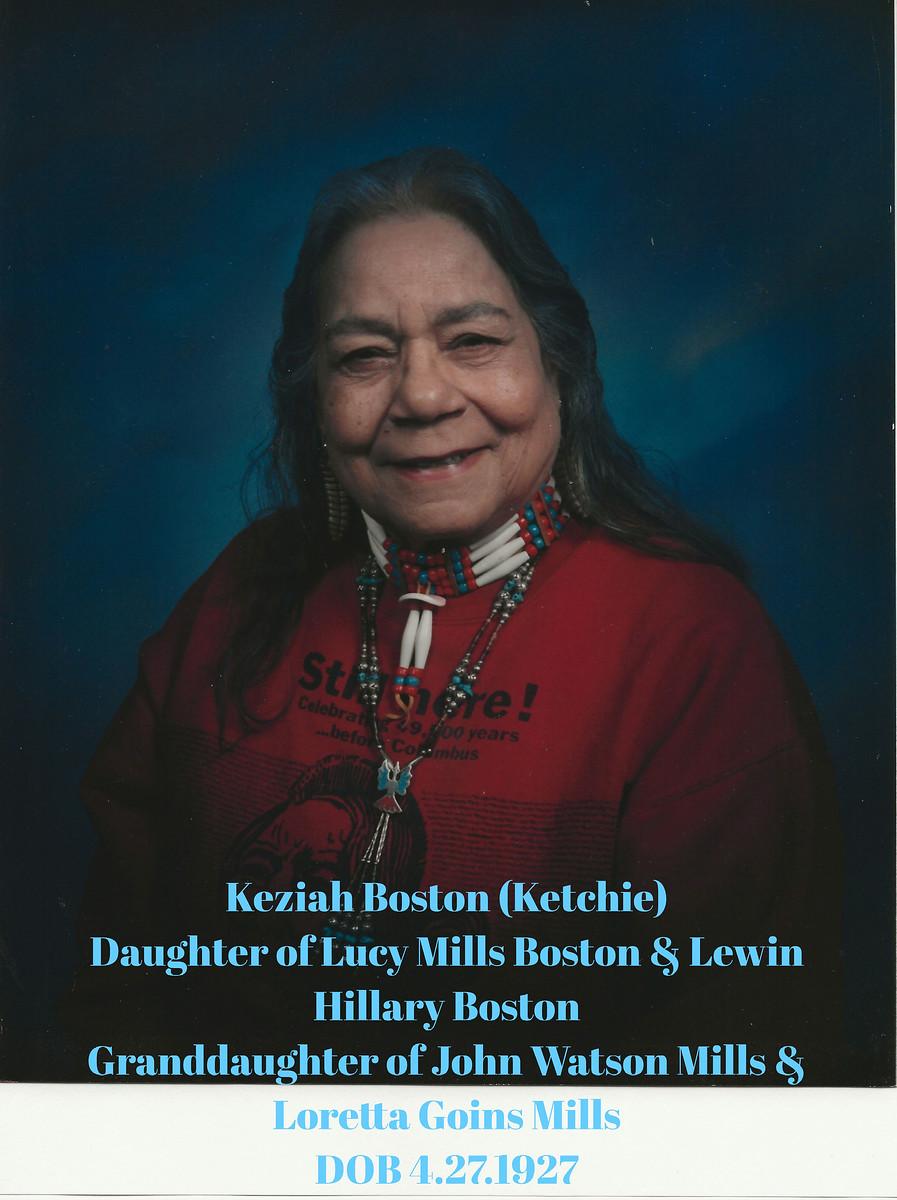
Above: A photo of the late Tauxenent’s Chief Keziah Boston who was elected to that position along with two Assistants to the Chief, Billy Payne and Rose Powhatan. She, her assistants, and the tribe's council were the first installed since the recorded weroansquaw, Keziah Powhatan and her Fairfax County warriors burned down the county’s courthouse around 1744. Chief Keziah Boston was of Dogue, Pamunkey, and Wampanoag descent, marking the revival of Northern Virginia’s tribal nation, the northernmost national member of the historic 32-34 members of the Powhatan Paramountcy. These nations continued to intermarry over the centuries, creating multiple kinships.

  
Above: Son of the Chief, an Assistant to the Chief, Billy Payne.


Assistant to the Chief, Rose Powhatan 

The Tauxenent/Dogue Weroansquaw, Keziah Powhatan was memorialized by her descendant, Rose Powhatan in a 2023-2024 Native American art exhibition at the National Gallery of Art, Washington, DC, her hometown and ancestral territory, the northernmost segment of the historic Powhatan Paramountcy.

D.A.R. Plaque, Tyson's Corner, Vienna, Virginia commemorating the act of Werowansquaw
Keziah Powhatan and her warriors as "Indian hostilities".
A proposed Washington, DC Tauxenent/Pamunkey Land Acknowledgement plaque. 

A concept for a monument to Wahunsenachaw or the second  Powhatan, who had inhereted a group of eight Algonquian nations from his father, the First Powhatan in the Tidewater area of Virginia. By his 60s, Wahunsenachaw had created a confederation of over 32 nations to creat a Paramouncy that the arriving English considered to be a kingdom with princes and princesses. The Tiber Creek in the Dogue territory on a hill, which becamre Capitol Hill in Washington, DC was his favotite place to caucus with surrounding nations. (See Washington Post map below).

The sad fact is that the American words, "Dogue" and "Tauxenent" are not familiar names to most Washingtonians... 

Or even in the Metropolitan DC Area. 
Also...
  • Not to the general public.
  • Not to the Media.
  • Not to the DC Government.
  • Not to the Federal Government and its workers.
  • Not even to the private and Public Schools, or the many universities and other institutions of higher learning. 
QUESTION: WHY?

ANSWER: (a) Lack of interest? _X_.
                  (b) Misinformation?  _X_.
                  (c) Poor education? _X_.

To learn these Algonquian names one must see the maps below. If recent tribal names or groups claiming to be Washington, DC's tribes do not appear here, they were never a part of the Nation's Capital. And, today, there are a few historically undocumented claimants to DC! They seem unaware of the city's Indigenous history and have even spread misinformation about their Indigenous DC status to Congress, the Senate, the city’s government, and educational institutions in the DMV.  Their publicized myths about tribal claims of historic DC or the original Federal City origins are as erroneous as similar myths associated with the fictitious Pocahontas. At least she, the real historic Pocahontas, by descent can be considered to be a DC Native via her inclusion in her father's Powhatan Paramountcy Territory whose leader, Wahunsenachaw (aka the second Powhatan, or “Dreamer”), created the first 16th century *caucus on Capitol Hill. Chroniclers of the time said, “Powhatan never left his area.” *Caucus: From corcas. From Powhatan Algonquian: caucauasuor "counselor". First recorded by Captain John Smith. Today, it
is a political meeting to make decisions.
▼
John Smith's Map of the Virginia Territory that includes Powhatan's domain of 32-34 nations known historically as a Kingdom, Confederacy, or "Chiefdom", along with the "tribes" of the area.


  • Enlargement of the Washington Post's 2007 map of the Powhatan Confederacy's Dogue or Tauxenent Territory that included parts of today's Northern Virginia and Washington, DC.

1607: Powhatan Land and Water Areas = Approximately 16,000 square miles [Note: A Washington Post map by Gene Thorpe dated December 13, 2006, showed that the above land and water areas were between 18,700 to 19,250 square miles.]


The John Smith 1607 map above is more easily read than the PowhatanMuseum.com maps below. Their contemporary rendering, with the enlargement of a part of the Metropolitan Washington DC Area, marks an area of the Powhatan Confederacy's Territory of allied Algonquian Nations. The northernmost nation was that of the Dogues or Tauxenent whose descendants still reside in the Metropolitan Area and whose families have retained both family stories and an unbroken connection to their Native American heritage. Unless you know the names of these families, you may think that they had succumbed to **Document or "Paper Genocide." 


The Racial Integrity Law has contributed to the confusion of the racial identities of many individuals in the DC Metropolitan Area's population. With the influx of newly arriving populations, the issue of Indigenous survival is not generally known. Extinction of the indigenous people is more commonly believed by "newcomers", but is not limited to them. 


DC's HISTORIC INDIGENOUS INHABITANTS

The historical evidence shows that the two major Amerindian Algonquian nations were within today's finalized boundaries of Washington, DC. They are Tauxenent on both banks of the Potomac River and were the Nacotchtanks (Anacostins) on the Anacostia River. Only the descendants of the Tauxenents can be found in both DC proper and across the river in Fairfax and other counties of Northern Virginia. The historic Nacotchtanks were seen as leaders in the beaver fur trade, a commodity coveted by northern rival Native nations and the newly arrived English. The Nacotchtanks' main town was bombarded and destroyed by the English and their Potowomek allies (a Stafford County [Powhatan] nation for whom the River of the Cohonks was renamed, "Potomac", and the co-kidnappers of Pocahontas). The remnant Nacotchtanks survivors left the area to seek refuge and seemingly assimilated within other tribes, probably to the north and west.

For those still here, one just has to know the family names of the surviving Tauxenents of the Tri-state area. Unfortunately, currently, there is widespread confusion by some, especially a few writers and some groups who have belatedly laid claim on DC's Indigenous identity.    


==============================================
NOTES:
(1) Cockaoesque: https://www.washingtonpost.com/opinions/local-opinions/dc-indigenous-queen-cockacoeske/2021/03/25/793e8110-8c10-11eb-a730-1b4ed9656258_story.html

(2) Fairfax County: The Royal Gift

* Land belonging to the Right Honorable Thomas Lord Fairfax Baron Cameron, bounded within the Bay of Chesapeake and between the Rivers Rappahannock and Potowamack [Potomac] in Virginia.


** Document Genocide: (https://yamaye-mike.blogspot.com/2019/10/surviving-document-genocide_31.html) The systematic governmental erasure of Native American links to contemporary Virginia families. The practice was codified by the 1924 Racial Integrity Law enacted by the Virginia Government under the influence of Dr., Walter Ashby Plecker, Director of the state's Vital Statistics. The law, upon the pain of imprisonment, forbade the documenting of Virginia Indian's racial designation as "Indian". The Eugenics Movement copied by Plecker and Germany's Nazi Party was responsible for the denial of genetic descent from Virginia's Amerindian people. The victims off the reservation were deemed Non-Indian or "colored", a designation which led to "Negro" then "Black". Plecker's influence reached beyond Richmond, Virginia into the surrounding states and the District of Columbia.