Saturday, December 8, 2018

INFLUENCE OF THE TAÍNO & CARIB


Three Early European Writers
©2018 Michael Auld

The impact of the Caribbean on the Eastern hemisphere after 1492 was more extensive than has been reported. Many tropical foods like the Taíno anona became the welcoming Colonial American symbol as the “pineapple”. It was traditionally placed above a Kalinago (Carib) door jam for the same purpose. Brought into Williamsburg, VA, a major capital of the British U.S. Pineapples were brought in by sea captains arriving from Europe via the Caribbean. On some large dinners, the exotic complex fruit was rented out as a centerpiece on lavishly laid out tables.

Impressions of “The Indies” on European writers is even less known. Of note, the First was the Spanish novelist Garci Rodríguez de Montalvo who was a Castilian author who published “Sergas de Esplandián”.
The first published novel with Taíno influences. Based on a Taíno epic recorded by Fr. Ramón Pané in 1498 (in "Report about the antiquities of the Indians").
An excellent depiction of Queen Califia on her island of La California_www. Steve Simon
California takes its name from de Montalvo’s novel and the ruler of the mythological Island’s Queen Calafia, who was the “black”, virginal Amazon ruler of La California. It is widely thought that Calafia, which derived from the Latin calipha, was taken from the Arabic khalīf.

Sergas de Esplandián’s Island of La California was populated by amazons whose only metal was gold. The combined source of this “Island of Women” and one of Gold seemed to have come from the Taíno epic hero Guahayona and his travels to Matanino(the Island of Women) and his continued travel on to Guanin (the Island of Gold).

OTHER WRITERS
One Taíno word and their reported personality were influential on the Ehglish playwright William Shakespeare and the novelist Daniel DeFoe.

Shakespeare's


Caliban (Kali-ban)

Etching of a concept for Caliban. This is how the play portrayed a major character in Shakespeare's "Tempest". It is an illustration for the English audience's concept of a Caribbean Amerindian.


Above: Two English interpretations of Caliban. Below: Photograph of an actor's portrayal of Caliban as a Kalinago (Carib Anerindian) from the Eastern Caribbean. What has changed?
  • 1. The ugly, beastlike slave of Prospero in Shakespear's The Tempest. 2. One of the most examined and controversial characters in the 1611 play "The Tempest"  attributed to William Shakespear. Probably from caribalcaribalescanibales,  a European word for the Island Carib of the Caribbean.

Defoe's 
Illustration of Friday, Robinson Crusoe's Amerindian companion.

Friday (fri-day)

1. The sixth day of the week derived from Frig (“to copulate”), or Fria (Fria’s Day), the Germanic goddess of love. 2. A character from Daniel Defoe's 1719 novel The Life and Times of Robinson Crusoe.  3. Name given by Robinson Crusoe to his devoted male servant/companion. 4. A devoted male servant, aid or employee, especially having a high degree of responsibility.

  • The Spanish sponsored voyages to the Americas by Italian adventurer Christopher Columbus, had long lasting repercussions on both sides of the Atlantic Ocean. Initial encounters, like most first impressions, were often incorrect and caused irreparable damage to the indigenous peoples of the Americas.
  • Amerindian stereotypes have lasted throughout the ensuing centuries. For example, it is not unusual for the words "Red Indian" to be used to refer to people who were neither "red" nor "Indian". Red, from the annatto, or achiote pod, was one of the colors used to protect and adorn the skin of the Tainos and Caribs. "Indio" was a misapplication by Columbus who, for personal reasons, insisted that he had arrived at islands off the coast of India. Centuries of neglect and guilt by the emigres to the hemisphere have made indigenous people the least understood communities throughout the Americas.

Indigenous peoples of the Americas were composed of many ethnic groups which had a wide range of body types, skin colors, languages, and customs. Although Native Americans are genetically close to some "Asiatic" peoples they were not what Western Europeans thought them to be. First written impressions of the Tainos and Caribs came from Christopher Columbus's log of the voyages and letters to his royal backers. Ensuing 15th and 16th century debates about who these people of the Indies where and what were their origins have continued into our century. Writers have either romanticized or defamed them. An example of early attitudes towards indigenous Americans can be seen in The Tempest. Although the authorship of The Tempest by William Shakespear has been questioned, this play is thought to have demeaned Amerindians. Another author, Daniel Defoe, in The Life and Times of Robinson Crusoe, presented the character Friday as a noble savage and his pursuers as American cannibals.

The 1611 play, The Tempest , was based on a real life British shipwreck of the Sea Venture  in the Caribbean in 1609. The ship was wrecked by a Caribbean hurricane while on its way to the new British North American colony of Virginia . The word "tempest" was the English term for "storm". In 1611   the word "hurricane"
  • (from the Taino hurakan ) had not yet entered the English language. In The Tempest   the main characters were Prospero (the European magician) and his virtuous daughter Miranda . They were shipwrecked and marooned on an island inhabited by the creature, Caliban. Caliban was characterized as a vile and inhuman being.  Prospero seized the island and enslaved Caliban (a typical mindset of the period) who came to be despised by the magician. Prospero's superior intellect failed to civilize or humanize Caliban. This curious creature was probably created around popular 17th century rumors about the Island Caribs who Columbus’ men in 1493, had maligned as cannibalistic ( a Kalinago tradition of keeping the bones of revered ancestors in hanging baskets inside the home). Some Shakespearean experts believe that Caliban is derived from the early variation of the words Caribal, Cannibal, Caniba or Carib, from the Taíno “strong men.”. The Island Carib call themselves “Kalinago”.
In colonial Virginia the British were so wary of the Carib's war-like reputation in the Caribbean that they passed a law in the House of Burgess to hang every Carib who was brought to the colony. The Tempest also revealed the prevailing ethnocentric and paternalistic attitudes towards the Caribs. These were common traits exhibited by Europeans towards the indigenous populations in the early forays into the Americas. The British playwright described Caliban as a "weak and deformed slave". Because of his plight Caliban was misidentified in some plays as African or Asian, who themselves were later subjugated by the British Empire.
In later centuries many colonized or subjugated peoples identified with Caliban's dilemma.
Daniel Defoe also based two stories on an actual marooning of a Scottish sailor on the Juan Fernandez Islands off the shore of Chile. In 1704 Alexander Selkirk had a dispute with the captain of the pirate ship on which he was the first mate. Selkirk requested to be put off on the island and was later rescued by anothter English pirate ship in 1709. Defoe's famous stories which were based in this incident were "Treasure Island"  and "The Life and Times of Robinson Crusoe".  Marooned on a tropical island after a shipwreck Defoe's character, Robinson Crusoe, came across some human tracks on the beach. The footprints turned out to be those of another human being who Crusoe named "Friday".  
Both Treasure Island  and The Life and Times of Robinson Crusoe  are envisioned as Caribbean tales. Notorious pirates and shipwrecks by hurricanes were part of the early history of this geographic area. British pirates of the Caribbean were also called buccaneers and often with the clandestine approval of the monarchy, harassed the Spanish in the Americas at will. 
Buccaneers began on an island off the coast of Haiti (Hispaniola). They were French woodcutters employed by the Spanish to harvest exotic Caribbean woods for export to Spain. Expelled from Hispaniola, they set up barbecoa shops on an Island. The French called the barbecue grill a “bucan”. They were called “bucaneers”, men who sold barbecue pork and beef to passing ships. Soon, they began to rob their customers and became roving “buccaneers”.
The turbulent Caribbean was not Defoe's source for his stories and some writers believe that Friday could have been an Inca man escaping   the allegedly "cannibalistic" Puna Islanders. During Defoe's time prevailing attitudes towards the indigenous people of the Caribbean makes it more probable that the character, Friday, was visualized as Taíno and his pursuers were conceived as "cannibalistic" Caribs.
At first, the Caribbean’s idyllic location, its exotic Amerindian people, its imaginative mythology had made an indelible impact on the Eastern Hemisphere. Soon, it also tapped into the deepest fears of homeland Europeans who were already primed with their own macabre tales. They sometimes believed that local tales like The Eternal Fountain of Youth (a type of Medieval Viagra) was realized in the Caribbean. “Las Siete Ciudades de Cibola” became the “Seven Cities of Gold”, believed to be located in New Mexico’s Zuni territory. The pursuit of these myths caused the deaths of many Amerindians and Spanish adventurers. The initial greed was fueled by a drive was a thirst for women and gold. 
The Proof
The high percentage of mestizos and tons of gold and other treasures taken out of the Americas. Case in point: Hernan Cortez's belief in Garci Rodríguez's popular novel, Sergas de Esplandián , is revealed in his actions below. 
The Aztec’s Triple Alliance was defeated. Cortez stood on the dry, cactus strewn landscape of Baja California, looking out at the towering, mountainous “La California Island”, convinced of a nearby paradise with virginal amazons whose only metal was gold...

 NOTE:

*Kalinago (Island Carib) of Dominica, Eastern Caribbean

Descendants of the people who were maligned by Columbus' reports and Shakespeare's play live in Dominica, Eastern Caribbean.. 

Center Top: Chief Irvince Auguiste.
Bottom, Left: Hermine, 7th grader.
Bottom, Middle: Filex Francis, basket-maker. 
Bottom, Right: Napoleon Sanford, traditional canoe-maker.
Chief Irvince Auguiste, Carib Reserve, Dominica (1992)

Friday, November 30, 2018

PAMUNKEY BY BLOOD

Honoring Georgia Mills Jessup (Pamunkey).

©2018 Michael Auld

Georgia Mills Jessup in front of her three grandsons who were wearing a Pamunkey Seal (Left), a "Still Here" (Center) and a sacred Turtle (Right) T-shirts.


WHAT BECAME OF WASHINGTON'S INDIANS?

To close out National Native American Month it is fitting that the Powhatan Museum honors an accomplished DC Native, artist, and arts administrator, Georgia Mills Jessup (Pamunkey). She was a mother to equally accomplished visual and musical artists who excelled in their own fields.

Although the Pamunkey were the leading tribe in the vast Powhatan Confederacy, a 34 large confederation of Algonquian speakers, it was most likely the Dogue/Tauxenent town of Nameroughquena, that ruled over parts of the southern portions of D.C. and it's Virginia Metropolitan Area at the time of the arrival of Captain John Smith (1607). The other major tribe who shared DC were the now extinct (from the area), the Nacotchtank who lived on the banks of the Anacostia River and were soon annihilated by the arriving English and their Potowomec allies. The Nacotchtank had controlled the local beaver trade coveted by the English. Their survivors dispersed west, north, and south of Washington, D.C. Today's, there are no Nacotchtank
in Washington, D.C.

WASHINGTON'S ETHNIC ARTISTS

Washington, D.C. has a variety of ethnic artists from Europe, North and Latin America, Africa and Asia. Yet, it has never included a major Native American artist from the "endemic" Amerindian Powhatan Confederacy in a major one-person exhibition. Only the National Museum of Women in the Arts has one of Georgia's paintings in its permanent collection. Could it be racism or a lack of interest or ignorance of surviving Amerindians who were born, live and work in their ancestral area, Washington, D.C.? I believe ignorance, mythology and the Invisibility of the Indian are contributing factors. Current Washingtonians have no clues about the local Amerindian history and family survivors. This blog may clear up the question on who is a Native American—http://yamaye-mike.blogspot.com/2015/09/who-is-native-american-or-it-is-hard.html?m=1


GEORGIA'S FAMILY

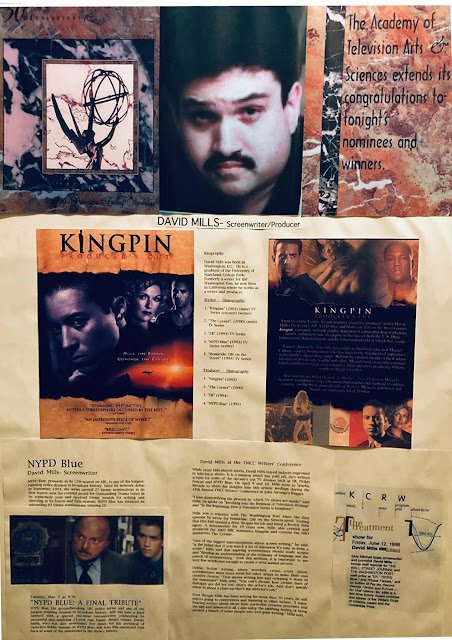
Georgia was #13 of 21 siblings whose family members' artistic disciplines included painting (murals and canvass), photography, medical illustration, graphic design, ceramics, installations, arts administration, art law, writing, music, television, and theater. For example, Georgia's nephew, "David Eugene Mills was an American journalist, writer, and producer of television programs. He was a writer for ‘NYPD Blue', an executive producer and writer of the HBO miniseries ‘The Corner', for which he won two Emmy Awards, and the creator, executive producer, and writer of the NBC miniseries ‘Kingpin' [for which he drew from family experiences]. "—Wikipedia
Yet David's D.C. Native American (Pamunkey) ethnicity was misidentified by his co-workers.
David Mills: A poster of his accomplishments


Georgia was a grandmother to an engineer, law graduates (one of whom is a lawyer for the arts) while the other is deeply involved in Native American health issues.

Although Georgia shared artistic skills with many of her siblings and relatives ("21...And Counting: Artists in the Family" -in the 1960s), we honor her for her own creative accomplishments in the city where she had stood out as the most talented local Native American Fine Artists that D.C. produced. Most importantly, she was born in the city, often earlier visited by her paternal Pamunkey relative, Wahunsenacawh, also known as Powhatan II.

As some of her cousins did, she married into a local Native American family who was from the Dogues/Tauxenents, indigenous to Northern Virginia and N.W. Washington, DC.


L: Georgia with her Boston (Tauxenent) in-laws in front of their traditional barn, Fairfax County, VA. Tauxenent men were historically tall.

They were described as "Powhatan II's last frontier" of a 32-34 Algonquian nations confederation. http://www.powhatanmuseum.com/Powhatan_Map.html

The Tauxenents themselves produced accomplished local musical and visual artists that included an award-winning White House photographer, Georgia's late relative, Bernie Boston (Tauxenent). Below is Bernie's iconic "Flower Power", a Vietnam War protest era photo nominated for a Pulitzer Prize.

Bernie Boston's iconic photo shows a Vietnam War protester placing a flower in the gun barrel of a National Guard soldier.


HER STORY

Georgia's published article:

"We're Still Here: Pamunkey John Miles/Mills: his life and family in Fairfax County" proudly tells of her Pamunkey descent. [ http://powhatanmuseum.com/Powhatan_People.html ]

She also has honored her historic city of birth in her paintings. A location whose history predates European contact when in the late 1500s it was a favorite location visited by her Pamunkey relative, Powhatan II. Powhatan II found this northern part of his extensive territory, the place now called Capitol Hill, to be his favorite place to caucus. The "caucus" was a deliberative Powhatan Algonquian tradition, also used for inter-nation deliberation.

Georgia was true to honoring her Algonquian city's Native roots with her paintings of the Capitol dominating the city-scape, a tongue-in-cheek to the true demographics of DC during the 1960s, hidden below ground of a white marble Capitol Building.


"Urban Renewal" is a commentary about DC after the 1968 riot. Washington began displace some of the city's less fortunate citizens who appear as a huddled brown mass under the Capitol.
Another painting of this genre hangs in the permanent collection of the National Museum of Women in the Arts, titled "Rainy Night Downtown."

This painting is of a popular DC nightspot location and now the place where the Women's Museum is located
.
Georgia and her painting "Rainy Night Downtown" at National Museum of Women in the Arts, Washington, D.C.

 "Rainy Night Downtown".


A DC exhibition of contemporary Powhatan artists who wanted to make their continued presence felt was held at Fondo del Sol Museum in Washington DC's DuPont Circle was titled:

Georgia's indigenous inspired painting, "Shaman" was the exhibition's featured painting.

Shamanism Was America's First Religion...
and continued long after European contact.

Proof that the ancient Amerindian religious practices had continued in Virginia is evidenced by Georgia's secretly working spiritual objects in this painting. (Information from the artist.)

"Shaman" honors America's indigenous religious practice. It is a Pamunkey inspired painting that included sacred items from a medicine pouch worn by Chief Paul Miles, another of her Pamunkey Reservation relatives. Objects incorporated from the sacred pouch was a gift from her late cousin, Chief Bill (Swift Eagle) Miles.

RATIONALE:

For Georgia, growing up in segregated Washington, DC did not faze her. Art doesn't lie... either you were a good artist or a mediocre one.

Georgia grew up in a segregated Washington DC and Northern Virginia of the 1930s through the 1940s to 2000s.

A SIGNIFICANT INFLUENCE
Nineteen twenty-four greatly impacted on Virginia's Native American populations and beyond. It marked another page to "Paper or Document Genocide." This was another chapter in US Governmental attempts to destroy the Native American populations. Just, without spilling blood, write them out of the census. After the 1924 Racial Integrity Act in Richmond VA, it was difficult to survive as a "Hidden Indian" in rural Fairfax County and the Nation's Capital, especially if you were bright and talented. The Act, spearheaded by eugenics proponent Dr. Walter Ashby Plecker, made it punishable by imprisonment, anyone who placed "Indian" as the race of an individual's birth certificate. Plecker believed that America had just two races, one white and the other black. His goal was to eradicate the Indian, a tactic the Nazis came to America before WWII to learn about how to apply this movement to Germany's Jews.

So, some Native families knew their tribal names, but many went underground.

Above: One of Georgia's many ceramic pieces using a more contemporary approach to traditional Pamunkey pottery by incorporating painting. (Her BFA was in painting while her MFA was in ceramics.)

DC did not recognize its local Native Americans, only those dignitaries who, as parts of delegations, occasionally visited from "out West". As for the local populations, most mistakenly believed that "the Indians were all killed out." The only prominent Native presence in the city and surrounding suburbs are the derogatory Redskin football mascot and the team's name.

Some local Native families kept their family secrets for fear of ridicule or skeptical believers in the racist "One Drop Theory." That is, "one drop of Sub-Saharan ‘blood' makes one Black. Today, this racist theory is still believed and enforced by self-appointed "race police". The fact in DC, as was true of other cities, if you were not white you had to live in the Negro part of town. Full blood Cherokees and Delaware Natives ran into the same segregated housing issues. Brown-skinned Natives were misidentified as "colored,"

It is important to mention this applied un-scientific theory that was created by America racists since it impacted on the life and career of Georgia Mills Jessup. During the last 30 years of her life, Georgia reconnected with and worked closely on Native issues with her cousins on the Pamunkey Reservation. She, Chief Bill Miles and his wife, Ann (a genealogist) stayed at each other's homes while doing family research and tribal business.


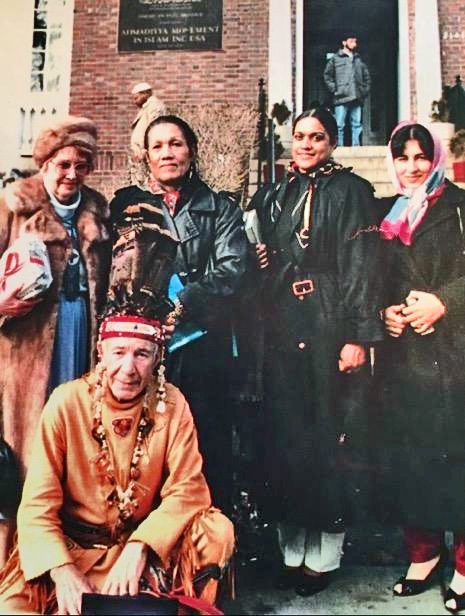
Washington, DC visit to a local organization which wanted to help the Pamunkey Reservation by providing health care. (L-R) Georgia's cousin,  Pamunkey Chief William Miles (front). Ann Miles, Georgia Mills Boston Jessup, daughter Rose Powhatan with DC religious organization's representative.

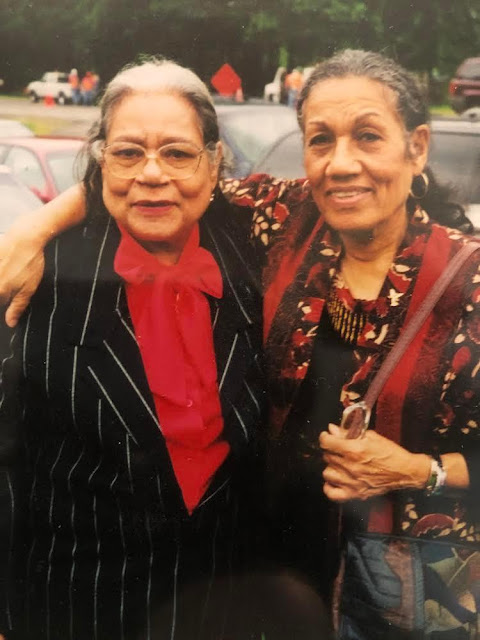
Georgia and her cousin, Chief Keziah Boston (Tauxenent) tribe of Northern Virginia
and Washington DC
.

In spite of adversities created by external identity challenges, she was extremely successful in reestablishing her indigenous ties to her beloved city in "Attan Amaik" (Powhatan Algonquian territorial name which translates into "Our Fertile Country").


Wednesday, November 14, 2018

HONORING NATIVE CONGRESSWOMEN

THE POWHATAN MUSEUM 

(powhatanmuseum.com) 

©2018 Michael Auld

Above: Seal of the Powhatan Museum with Wahunsenachaw's two totems with a man flanked by a deer and mountain lion.

OUR *ATTAN AKAMIK TRADITION WAS TO WELCOME NATIVE LEADERS TO OUR POWHATAN TERRITORY

TRADITIONAL HOSTESS #2: Cockacoeske,
Queen of Pamunkey (his relative) who signed 

the Treaty of Middle Plantacion in 1677. 
The treaty ceased all hostilities between Native
Americans and the English who were
succeeded by the Americans.
TRADITIONAL HOST #1: Wahunsenachaw
(Powhatan II) his father's successor who 

expanded the Confederation of Algonquian-
Speakers from North Carolina to 
Maryland and Washington, DC.
He laid the foundation for the founding
of the United States of America.

THE POWHATAN MUSEUM
PROUDLY HONORS AND WELCOMES OUR TWO NATIVE AMERICAN CONGRESSWOMEN TO CAPITOL
HILL...


...During this auspicious National Native American Month. May your stay in our historic *Attan Akamik (Powhatan Confederacy Territory, a.k.a. “Washington, DC”) where Powhatan II presided over the earliest-known meetings on Capitol Hill that the Powhatan called a “caucus”. May your future caucuses be as successful as his.

*Attan Akamik = “Our Fertile Country”.  


Congresswoman Sharice Davids (Ho-Chunk Nation)

Congresswoman Debra A. Haaland (Laguna Pueblo

Both appropriately won seats in Congress on November 6, 2018 during the month that honors Native American cultures and peoples.


Thursday, November 1, 2018

Chewing Sapodilla Gum

The Sapodilla tree first seen by the Spanish in the Taino Caribbean, is a tree endemic to Central and South America and the Caribbean and is the source of chicle. A sticky, milky white sap collected today by chicleros and processed into world popular chewing gum as Chiclets, et al. Notice the name "Adams" on the Chiclets packet. He "inherited" Santa Anna's chicle that the general had brought to Staten Island from Mexico. 
©2018 Michael Auld  
Sapodilla (sap-o-de-ya) 
1. From the Nahuat (Mexica) word tzapotl (za-pot). 2. A large evergreen tree of tropical America, bearing a brown, rough, sweet, edible fruit and yielding chicle (chick-lay) 3. The fruit of the tree. 4. Also called sapodilla plum, sapota, Chico, Chico sapote, Zapote chico, Zapotillo, Chicle, Naseberry, etc. 5. Not to be confused with a different fruit, the sapota. 6. The source of chewing gum ; a sweetened and flavored preparation for chewing, originally made from the dried sap, chicle, of the sapodilla.

Early ad for Chiclets with the fruit-like 
Sapotilla/Naseberry shaped pendant.
Chewing Gum has a history in both Eastern and Western Hemispheres. The ancient practice in the Tropical Americas was the sap of the Sapodilla tree. North American Natives chewed sap from the spruce tree. Chicle from the Sapodilla tree was introduced to New York by the conqueror of the Texans at the Alamo, Antonio Lopez de Santa Anna. After 1860, Americans were hooked. It is ironical that contemporary Americans (especially their soldiers) are hooked on chewing gum from people South of the Border who are seeking asylum from countries that produce the most chicle.


VERY EARLY CHEWING GUM

"One of the oldest pieces of chewing gum dating back 6,500 years (C&EN, March 24, 1997, page 64) from Bokeburg, Sweden is believed to be from a natural tar.  Elizabeth Aveling, University of Bradford, England, analyzed it and thinks the source was birch." 

It is obvious that humans have been chewing gum, mostly from the sap of trees for thousands of years. First encountered in the Caribbean after 1492, chewed by the Taino, chicle provides the highest portion of natural sap in the making of chewing gum today.  The Taino, originally a South American people who possibly also chewed chicle as the local Central Amerindians did, continued to do so in the Caribbean where the Sapodilla tree was endemic to the area.

Although today chewing gum is also made from synthetic materials, much of the natural sap, chicle, is harvested from the Sapodilla tree, and mainly from Mexico, Guatemala and Belize in Central America. The Sapodilla trees are cut in a zig-zag pattern, the white sticky sap is collected in small bags. The chicle is "boiled until it reaches the correct thickness. [Amerindians] who collect chicle are called chicleros."--Wikipedia

Chicleros and the gathering chicle from the Sapodilla tree in the South American forest,


The Sapodilla tree and its fruit made their debut to the newly arriving Spanish in the Caribbean soon after 1492. Its not called by its Taino name but by the later Nahuat (Mexica) derived word "sapodilla" or the English term"naseberry." The tree, Manilkara zapota, is the source of two popular treats. In the tropical places where it is grown or exported, it is a delicately sweet, brown, egg-shaped fruit. Although the dry sap, chicle, was chewed by the ancient Maya and its wood used as support beams in temple construction, to the world it is the source of chewing gum and is associated with American popular culture. 

Chicle's recorded entry into the United States began in the late 1860's with Antonio Lopez de Santa Anna the former Mexican president and famous general of the Battle of the Alamo. The fruit's value as an exported item to the Eastern Hemisphere, is evidenced by the many countries which now grow the tree and has more than 29 international names for the fruit. For example, India alone also has 30 named cultivars each with distinctive characteristics for the fruit they call baramasi (Bengal and Bihar), chikoo, chiku, sapota or sapodilla plumb.


The tree is an ornate, large shiny leaved evergreen native to the Caribbean and Central America. It can reach 100 feet high and produces 2,000 to 3,000 fruits per year. Grown in the wild and as a fruit tree it has many uses. Its hard red wood is used economically for lumber, its milky white sap is used as chicle, and its fragile fruit is not easily marketed away from the source of its production. Sap from the bark of Sapodilla tree, like most plants which produce a similar liquid, was protection against insects and animals. The sap was exploited by indigenous Americans of  Mexico who chewed the dry resin while the fruit was praised by the Aztecs and was grown and enjoyed by the Tainos.


Tree resins have been highly prized by humans for many years.  On Columbus' first trip into the Caribbean he was on the lookout for "mastic." (An aromatic sap from a small Mediterranean tree used in making varnishes and adhesives) The habit of chewing gum was also found among the early Greeks and Turks who chewed the resin of the mastic tree. In a similar contemporary fashion, some Jamaican children chew a gum from the dried sap of the imported Polynesian breadfruit tree.


The use of the "blood" of trees for a variety of reasons was widely practiced in the Americas. The Maya used quic (blood) from the rubber tree in the process of vulcanizing rubber (a skill which is believed to have originated among the Olmec). They also made a fragrant copal incense for burning in the temples. There is also the turpentine tree (Bursera simaruba) used as a sealant. The Island Carib (Kalinago) used the "blood" of the gommia tree as an ingredient in making a weather resistant, waterproof wood sealant for their canoes. Eastern Woodland people of North America made syrup from the sap of maple tree and chewing gum from the spruce. Mexican chicle chewing made its way to the U.S. market (and ultimately the world market) in the late 1860's through the infamous Mexican leader Antonio Lopez de Santa Anna.

The Alamo's Santa Anna and the American Chewing Gum Industry

Antonio Lopez de Santa Anna: The man who brought chicle to the United States.

Born in the state of Vera Cruz in 1794, entering in the army at 16, Santa Anna led the victorious Mexicans in the battle against the Alamo. He was  later defeated by Sam Houston at the Battle of San Jacinto on April 21, 1836. Before the battle he was sidetracked through the intrigues of  Emily West, a beautiful mixed race (mulatto) enslaved woman from the island of Bermuda. She is believed to be the person in the song *"The Yellow Rose of Texas", a notorious personality in a supposed "love triangle" between Sam Huston of Texas and Santa Anna of Mexico. Santa Anna had a checkered life of victories and defeats in the Mexican military and politics. He directly ruled Mexico eleven times and his left leg had been blown off by a French cannonball in 1839 during his country's turbulent history of independence. Of Spanish decent he indulged in the Maya practice of chewing the gum called chicle. In one of his exiles, as a result of another ouster from Mexican politics, Santa Anna found refuge in New York's Staten Island in 1869. He had brought with him a large quantity (around a ton, although two tons have also been reported) of chicle. Santa Anna had the idea of having the chicle processed into rubber for carriage wheels.

Santa Anna sought the services of the inventor, Thomas Adams, for he wanted to find a way to refine the chicle into a rubber substitute. Adams' experiments failed since the mixture remained lifeless and did not bounce. Upon a visit to a drugstore Adams saw a little girl buying the popular sweetened chewing condiment made from the wax paraffin. Adams thought that the paraffin made a "pretty poor gum," He remembered Santa Anna's comment on the Mexican use of chicle as a chewing gum. Adams asked the druggist if he would be willing to try another kind of chewing gum. The druggist agreed and Adams hastened home to soak and knead the ancient Maya chicle into grayish balls of gum. The druggist sold out of the gum in one day. In 1876 Thomas Adams, a glass merchant, formed Adams Sons and Company with his two sons. He sold gum with the slogan "Adams' New York Gum No. 1 -- Snapping and Stretching." The firm was the largest and most prosperous chewing gum manufactures in the United States and in 1899 formed a monopoly with the six largest chewing gum manufacturers in the United States and Canada. It was renamed the American Chicle Company and they produced the popular chewing gum Chiclets.

Although an ancient indigenous tropical tree and fruit the chewing gum residue litters the sidewalks of major American cities. For this reason, chewing gum, perceived as a bad habit, is banned in schools and some foreign cities. American habit the chewing of chicle is associated with contemporary popular culture from the United States. The chewing of gum can be considered to be a nasty habit yet it is associated with calming of the nerves. It was promoted as just such a remedy for soldiers in the heat of battle during World War II. The effectiveness of chewing gum is probably due to the result of salivation, combined with the cleansing influence of mastication. Not accepted in certain social circles, there are other negative aspects of excessively chewing gum. These down sides are, the wear it places on joints connecting the jaw and the preparation of the stomach for a meal it will not get.

Mexico is the largest producer of chicle which makes up about 30% of today's chewing gum. Commercial Chewing gum may contain a blend of different kind of latex from tropical trees, resin from pine trees, and synthetic made from materials like polyvinyl acetate, various waxes and imitation rubber. It could also contain corn syrups, sugars, glycerin and literally hundreds of flavorings. There are also natural chewing gums made from "Rainforest Chicles", evaporated cane juice, rice syrup, filtered water, natural flavor oil and natural colors. The most natural product of the Sapodilla tree is the brownish translucent flesh of the goose-sized egg-like fruit.


The size and shape of a roughly textured brown egg (almost like a kiwi fruit), the sapodilla or naseberry flesh is sweet as honey and granular like a peach. Rarely found outside of its tropical habitat, because of its delicate fruit, the tree was taken to the Philippines by the Spanish. It is also grown in Florida since the tree can tolerate cool weather. The fruit has from two to ten flat shiny black seeds from which the the bitter white kernels are used to make a tea. The sweet-smelling fruit is more often eaten raw when very ripe or cooked, or pureed, or pressed to be made into a juice. The Sapodilla makes delicious sauces, jam, sorbets, ice cream and an excellent wine. The fruit is high in fiber and contains a great amount of potassium, as well as vitamin C, sodium and iron. It is found in yards as a fruit tree and in markets in tropical America and may are bought in some Caribbean stores in the United States and England (as naseberry)
________________________________________________
*SONG: "The Yellow Rose of Texas" sung by the famous movie star, Roy Rogers (Who was part Choctaw Native American). https://www.youtube.com/watch?v=rPM7zzElj-Q

Saturday, October 20, 2018

Anansesem’s GOLDEN STOOL OF ASHANTI


 Anan-se-sem: (Twi) AnansiStories, the stories of Kweku Anansi the Spider-Man, owner of all stories. The name "Ashanti is also spelled "Asanti". 

©2018 Michael Auld

  • While some Western Europeans were caught up in the American Slave Trade, in the 17th century history was being made in West Africa. 
  • Although the Ashanti/Asanti is the largest tribe in Ghana, there are some beliefs that they had migrated down from Egypt. One belief this is so since they share many names –usually with Egyptian Gods.

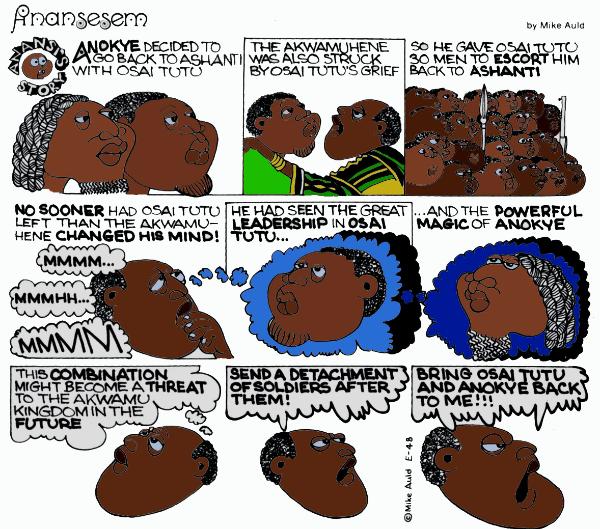
Panel 45 from "The Golden Stool of Ashantu (Asanti)", an Anansesem story by Michael Auld that illustrated the rise of the Asantehene (King) Osei Tutu and the 17th century creation of the formidable Ashanti Confederacy.


Panel 49: On a Friday at a gathering of royalty and Queen Mothers in Kumasi, Anokye the Priest, brought down from a cloud of  white dust, a decorated Golden Stool that gently perched on Asantehene's Osei Tutu's knees. They witnessed the birth of the Ashanti Confederacy.


The Story of the Golden stool of Ashanti not only belongs to these people of Ghana, West Africa, but many descendants who arrived in the Americas during the period of enslavement. It is evident that before their gaining of political power, some were traded to the English as prisoners of war. While the Americas were embroiled in the African Slave Trade, some Akan people were sold into slavery by the more powerful surrounding West African nations. The area became to be called the “Gold Coast” because of its rich deposits of alluvial gold.

This is the reason why the Ashanti Kingdom’s dignitaries, ornamentation, jewelry and sculptures area dripping with gold.(See Ashanti gold weights used for measuring gold.) The most revered object to the Ashanti was the Golden Stool, created in Heaven.

  • That the Ashanti became formidable warriors is evidenced not only in Ghana, but by historic Maroon (“Maroons are people who escaped the sugar plantations to join the island’s Yamaye Taíno “Cimarrones” in the mountains). Their leaders in Jamaica were those who successfully and strategically fought the English military in Jamaica. Under Captain Kojo and Nanny and his brother, Quao, obtained independence from the British before the American Revolution.

Starting in the late 17th century, the Ashanti king Osei Tutu ( c. 1695 – 1717) and his adviser Okomfo Anokye established the Ashanti Kingdom, with the Golden Stool of Ashante as the sole unifying symbol for the kingdom. 

This Anansesem was a researched, published comic strip of a folkloric story about the Golden Stool of Ashanti, Asantihene Osei Tutu and his cousin Okomfo Anokye, the Priest and the founders of the Ashanti Confederacy.

For a video on the Golden Stool of Ashanti go to:

anansistories.com

Monday, October 8, 2018

JAMAICA'S TAINO DAY


The very first Taíno Day in Jamaica was in 2007.

©2018 Michael Auld

(Jamaica annually celebrates Taíno Day with educational programs, lectures performances and exhibitions.)
 
Indigenous Yamaye (Jamaican) Taíno  symbols

While the US observes Columbus Day in October, Jamaicans, instead,  celebrate Taíno Day on May 5th. By way of many conferences, the day for honoring the Taíno was in 2007. Conversely, the USA is stuck with Columbus Day to placate its influential Italian émigrés who revere their hero, Saint Christopher. And a deep Eurocentric need to discover people into existence. Where as Jamaicans, once removed from under British yoke in 1962, began to challenge old notions and charted their own course and reality

Yet, a growing number of Americans have arrived at the same conclusion as Jamaicans did in 2004, by wanting to abolish the celebratory day that honors a man whom caused the Amerindian Holocaust. Jamaica, by way of much deliberation, has led the way to honoring the Indigenous people of this hemisphere instead.

How Jamaica Did It.

“In 2004, during the Haitian Bicentennial, the Jamaica National Heritage Trust (JNHT) discussed the possibility of replacing the contested “Encounter Day”, an annual commemorative event on the organisation’s calendar usually held on May 5 to mark the meeting of the cultures, with the equally contentious “Taino Day”. Actually, my preference as a historian was for “Indigenous Peoples’ Day,” in order to be more inclusive of the civilizations which existed in the island before the invasion by the Europeans.

“We wanted to introduce Jamaicans to Taíno, their knowledge of the rest of the
Caribbean; their regionalism; their belief system; their economic, social and political systems. The idea then, that our history should always be determined by what happened after the European colonization was unpalatable to some of us.”
--Prof. Verene A. Shepherd, former Board Chair, JNHT—

The first Taíno Day was a historic occasion, with the participation of two members from the Kalinago (“Carib”) community in Dominica (who were then students at the Cave Hill Campus of the University of the West Indies and who were sponsored by that campus). Our guest lecturer was Professor Rita Pemberton from the St. AugustineTrinidad, History Department and there were in attendance hundreds of visitors and students from schools around the island. Those who could not attend were kept abreast of the day’s excitement by IRIE FM.

The second reason was to cement the idea firmly in the consciousness of youngsters that people were living in the Caribbean before Columbus’s invasion of the region.
“Why Taino Day? By Prof. Verene A. Shepherd, historian and former Board Chair, JNHT --  www.jnht.com/news/WHY TAINO DAY.pdf

Sunday, October 7, 2018

WHAT DOES COLUMBUS DAY MEAN TO AMERINDIANS?


Wooden sculpture titled “Rape of the Carib Woman” is an analogy of the European rape of the Americas.

A STOLEN HEMISPHERE

©2018 Michael Auld

This day above all, reminds Amerindians of the suffering from hemispheric genocide. To some non-Natives the day is one of celebration of their successful inheritance of “free” if not stolen Indian lands. Conscience of territorial theft does not matter to this latter group. Alter all, we have transferred the blame of Amerindian genocide to a distant past and massacres to anonymous “Spanish” and English “settlers”. Some even prefer to blame diseases over the wanton killing of human beings via destruction of their societies and anti-Indian policies. Currently, many Amerindians throughout the hemisphere are at risk. In the US (as it is in the Americas) suicide, poverty, alcoholism, TB  and many other maladies plague the survivors. These health issues are the direct result of displacement and stolen territories.

“The Receiver Is Worse Than the Thief”

This is a Jamaican saying about receiving stolen property. In this Columbus Day instance, we celebrate our fortunes inherited from holy "Saint Christopher".

I was born on a Caribbean island visited and stranded on for a year by Christopher Columbus. The island was Jamaica, that has changed the honoring of Columbus to Taíno Day

The Yamaye (Jamaican) Taíno attacked Columbus’ ship in war canoes as it first entered Yamaye waters. He was not welcomed. Columbus retaliated by killing a number of Taíno with war dogs and crossbow fire. His intent was to not retreat from people who did not want his presence. But he forged ahead to begin the destruction of sovereign nations in the Americas' Cir-cum Caribbean..

News had traveled fast among the Taíno in the Northern Caribbean and his presence was suspect. On Kiskeya (Haiti & the DR), just in the first year of his arrival, his stranded men, not satisfied by a Taino welcome, demanded more food and women from their host, a local Kacike.(ruler) They were subsequently killed after a skirmish for breaking a code of honor. Upon his return during the Second Voyage, he randomly killed many Taíno who were not even responsible for the massacre of Spanish barbarians. 

The Yamaye were right. Columbus and his crew turned out to be barbaric slavers, claiming Taíno territory under the name of foreign gods and a foreign country. As far as the Taíno were concerned the main Spanish god was Guanin, the Taíno’s 14k gold.

Hatuey a Haitian kacike said this to the Cuban Taíno after he had escaped the Spanish hanging of his queen, Anacaona in Ayti,


To paraphrase Hatuey;
“If you swallowed your Guanine trinkets to hide their god from them, they love him so much that they will cut open your bellies to retrieve him.” He advised the Cuban Taíno to gather their guanin in baskets and throw it into the rivers.


Who are the people that revere Columbus on his special day? 

They are the followers of a murderous, violent and racist man who also brought devastating diseases. He came through the Caribbean as a slaver collecting a people whom he said “would make good servants.” His men were the first European rapist of the Amerindians who stole entire islands. 

One story recorded by his friend, Cuneo, off the coast of St. Croix, described his rape of a Carib woman. 


“A captured woman from a canoe had accurately shot an arrow into the chest of one of a boatload of Spanish pursuers.” 
Her Carib companions were immediately killed, while she was brought on board Columbus’ ship. The Admiral gave her to Cuneo who described in detail how he thrashed her into submission with a rope, then he raped her.

This man, Columbus, responsible for starting the Amerindian Genocide, larger than Hitter’s Jewish extermination, is given a day of honor?