Sunday, May 12, 2019

DC’s Missing Indians

Case of the Disappeared 

The Tauxenent or Dogue and Pamunkey of the Metropolitan Area (or DMV)

Today, Washington, DC still shares in a national issue of  Crimes Against Humanity, the disappeared Indigenous population. America’s history against its indigenous people has continued since the arrival of their English predecessors in 1607. The newly formed Revolutionary Government continued its atrocities against millions of Native Americans. Today, the crimes continue with Disappeared and Murdered Native Women, to its murderous infection of imported pathogens (rats, diseased people and blankets), wars against humans they deemed “savages”, the 1924 Racial Integrity Act of Virginia which was exported to Washington, DC. This last act has contributed to the official disappearances of the city’s Tauxenent off to Dogue, and the Pamunkey descendants.

THE SURVIVORS

 Today, hundreds of descendsnts of Native Americans who have been Indigenous to the DMV for thousands of years have disappeared from the records. Yet newcommers to our city had deemed them disappeared. The main reasons? There is no establishedDistrict of Columbia tribal government. Yet, their descendants are everywhere... just victims of Virginia's importes 1923 Racial Integrity Law (click to read a blog on "Surviving Document Genocide" by Rose Powhatan).

Moving in and out of the city proper for to live, work, or for schooling on all levels, was the norm. Ancestors also worked in local DC stone quarried (one in the National Zoo off Quarry Road, NW) whose stones were used in building DC structures like the interior of the Washington Monument, a Smithsonian building, the eves of the Capitol Rotunda, canals, and even Georgetown's "Exorcist steps".  

Pamunkeys in DC:  (L-R) late Pamunkey Chief Willian (Bill) "Swift Eagle" Miles (stooping). 
Back row: Bill's late wife, Ann Miles; Bill's cousin, DC-born Georgia Mills Boston Jessup (Pamunkey) artist, DCPS School Administrator: Georgia's daughter, DC-born, resident Rose Powhatan  (Tauxenebt/Pamunkey); woman representayive of the Islamic Center of Washington, DC. Bill and Ann visiting from the Pamunkey Reservation, stayed with Georgia in her Maryland home while on an official 1980s tribal business with the Islamic Center who had offered medical care for the reservation.


Photos: (Top) Georgia Mills Boston Jessup (Pamunkey) with her painting, "Rainy Night Downtown", Permanent Collection of National Women in the Arts, Washington, DC.

(Middle) Bernie Boston (Tauxenent Councilman), White House photographer for the LA Times, with his Pulitzer nominated Vietnam Era bhoto "Flower Power".

(Bottom) Back & front cook cover of a novel by Rose Powhatan's son, a Lawyer for the Arts,  podcaster & author, Alexei Auld (Pamumkey/Tauxenent), born and educated in Washington, DC, an Columbia School of Law.

Like many surviving Amerindians one must know the names common to certain tribes, likr Bigay of the Navajo. or Mills/Miles and Cook of the Pamunkey, or Custalow of the Mattaponi Reservation, and more. And Washington, DC is no different. Arriving in DC for university in 1962, I met many Indigenous descendants and became a part of one of these extensiuve families with over 18 siblings with over 29 practitioners in the visual and performing arts. So taken by the arts accomplishments of these related families, I wrote a manuscript titles "29 and Counting", documentinf many members who had acomplished great national, international, and local heights in music, opera, drama, podcaster, author, arts education, the visual arts, biomedical communication, atrs law, and art terapy. 

All were proudly aware of their descent from the Dogue/Tauxenent, Wampanoag, and Pamunkey, the leading nation in the Powhatan Paramouncy with America's oldest reservation in King William County, Virginia, three counties in Southern Maryland (the current township of Pomonkey, MD). The Pamunkey counted Wahunsennachaw, his brother, Opichancanoegh, the War Chief, his niece Cockacoesque (the Queen of Pamunkey & DC), and Pocahontas as tribal members. Their Paramountcy foght thee Anglo-Powhatan Wars of Homeland Security, signing pivotal treaties with the spreading British Empire.
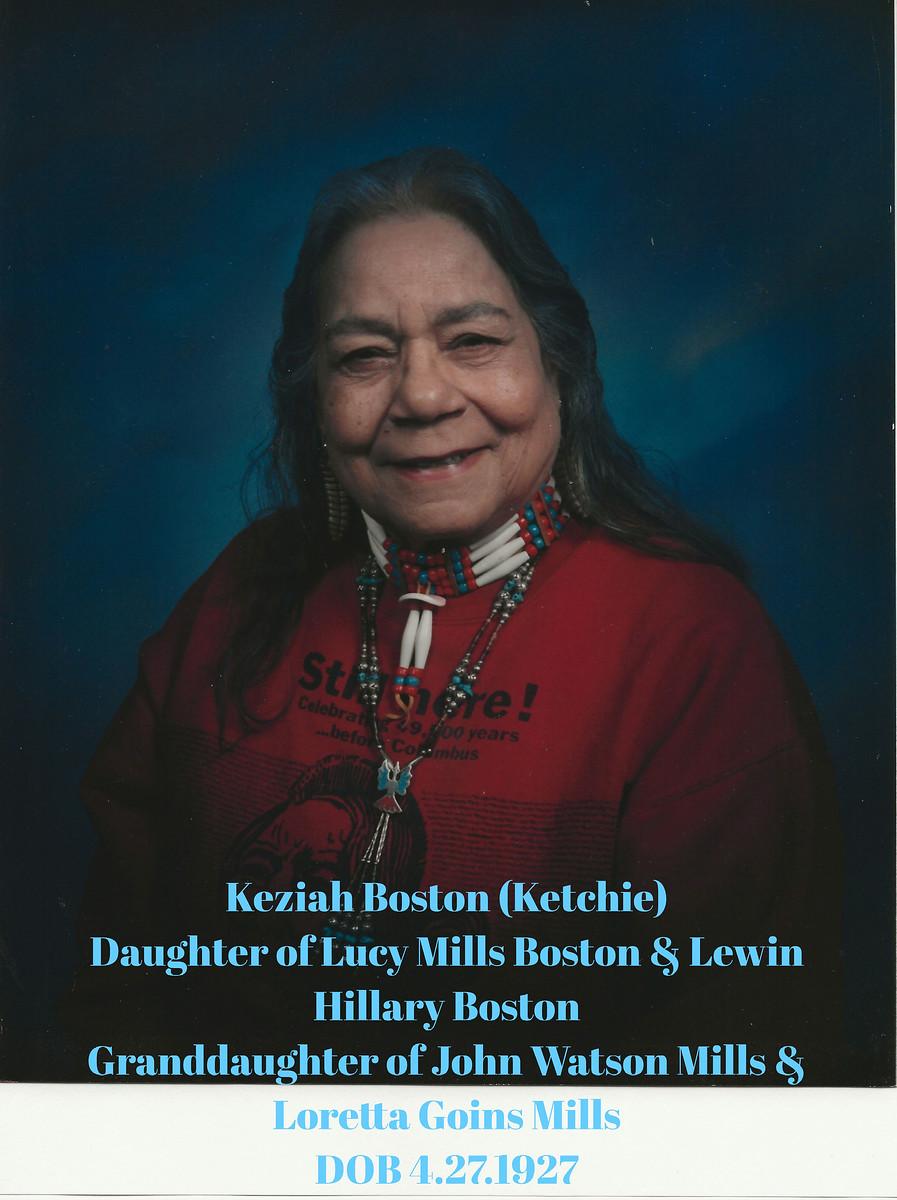
Above: A photo of the late Tauxenent’s Chief Keziah Boston who was elected to that position along with two Assistants to the Chief, Billy Payne and Rose Powhatan. She, her assistants, and the tribe's council were the first installed since the recorded weroansquaw, Keziah Powhatan and her Fairfax County warriors burned down the county’s courthouse around 1744. Chief Keziah Boston was of Dogue, Pamunkey, and Wampanoag descent, marking the revival of Northern Virginia’s tribal nation, the northernmost national member of the historic 32-34 members of the Powhatan Paramountcy. These nations continued to intermarry over the centuries, creating multiple kinships.

  
Above: Son of the Chief, an Assistant to the Chief, Billy Payne.


Assistant to the Chief, Rose Powhatan 

The Tauxenent/Dogue Weroansquaw, Keziah Powhatan was memorialized by her descendant, Rose Powhatan in a 2023-2024 Native American art exhibition at the National Gallery of Art, Washington, DC, her hometown and ancestral territory, the northernmost segment of the historic Powhatan Paramountcy.

D.A.R. Plaque, Tyson's Corner, Vienna, Virginia commemorating the act of Werowansquaw
Keziah Powhatan and her warriors as "Indian hostilities".
A proposed Washington, DC Tauxenent/Pamunkey Land Acknowledgement plaque. 

A concept for a monument to Wahunsenachaw or the second  Powhatan, who had inhereted a group of eight Algonquian nations from his father, the First Powhatan in the Tidewater area of Virginia. By his 60s, Wahunsenachaw had created a confederation of over 32 nations to creat a Paramouncy that the arriving English considered to be a kingdom with princes and princesses. The Tiber Creek in the Dogue territory on a hill, which becamre Capitol Hill in Washington, DC was his favotite place to caucus with surrounding nations. (See Washington Post map below).

The sad fact is that the American words, "Dogue" and "Tauxenent" are not familiar names to most Washingtonians... 

Or even in the Metropolitan DC Area. 
Also...
  • Not to the general public.
  • Not to the Media.
  • Not to the DC Government.
  • Not to the Federal Government and its workers.
  • Not even to the private and Public Schools, or the many universities and other institutions of higher learning. 
QUESTION: WHY?

ANSWER: (a) Lack of interest? _X_.
                  (b) Misinformation?  _X_.
                  (c) Poor education? _X_.

To learn these Algonquian names one must see the maps below. If recent tribal names or groups claiming to be Washington, DC's tribes do not appear here, they were never a part of the Nation's Capital. And, today, there are a few historically undocumented claimants to DC! They seem unaware of the city's Indigenous history and have even spread misinformation about their Indigenous DC status to Congress, the Senate, the city’s government, and educational institutions in the DMV.  Their publicized myths about tribal claims of historic DC or the original Federal City origins are as erroneous as similar myths associated with the fictitious Pocahontas. At least she, the real historic Pocahontas, by descent can be considered to be a DC Native via her inclusion in her father's Powhatan Paramountcy Territory whose leader, Wahunsenachaw (aka the second Powhatan, or “Dreamer”), created the first 16th century *caucus on Capitol Hill. Chroniclers of the time said, “Powhatan never left his area.” *Caucus: From corcas. From Powhatan Algonquian: caucauasuor "counselor". First recorded by Captain John Smith. Today, it
is a political meeting to make decisions.
▼
John Smith's Map of the Virginia Territory that includes Powhatan's domain of 32-34 nations known historically as a Kingdom, Confederacy, or "Chiefdom", along with the "tribes" of the area.


  • Enlargement of the Washington Post's 2007 map of the Powhatan Confederacy's Dogue or Tauxenent Territory that included parts of today's Northern Virginia and Washington, DC.

1607: Powhatan Land and Water Areas = Approximately 16,000 square miles [Note: A Washington Post map by Gene Thorpe dated December 13, 2006, showed that the above land and water areas were between 18,700 to 19,250 square miles.]


The John Smith 1607 map above is more easily read than the PowhatanMuseum.com maps below. Their contemporary rendering, with the enlargement of a part of the Metropolitan Washington DC Area, marks an area of the Powhatan Confederacy's Territory of allied Algonquian Nations. The northernmost nation was that of the Dogues or Tauxenent whose descendants still reside in the Metropolitan Area and whose families have retained both family stories and an unbroken connection to their Native American heritage. Unless you know the names of these families, you may think that they had succumbed to **Document or "Paper Genocide." 


The Racial Integrity Law has contributed to the confusion of the racial identities of many individuals in the DC Metropolitan Area's population. With the influx of newly arriving populations, the issue of Indigenous survival is not generally known. Extinction of the indigenous people is more commonly believed by "newcomers", but is not limited to them. 


DC's HISTORIC INDIGENOUS INHABITANTS

The historical evidence shows that the two major Amerindian Algonquian nations were within today's finalized boundaries of Washington, DC. They are Tauxenent on both banks of the Potomac River and were the Nacotchtanks (Anacostins) on the Anacostia River. Only the descendants of the Tauxenents can be found in both DC proper and across the river in Fairfax and other counties of Northern Virginia. The historic Nacotchtanks were seen as leaders in the beaver fur trade, a commodity coveted by northern rival Native nations and the newly arrived English. The Nacotchtanks' main town was bombarded and destroyed by the English and their Potowomek allies (a Stafford County [Powhatan] nation for whom the River of the Cohonks was renamed, "Potomac", and the co-kidnappers of Pocahontas). The remnant Nacotchtanks survivors left the area to seek refuge and seemingly assimilated within other tribes, probably to the north and west.

For those still here, one just has to know the family names of the surviving Tauxenents of the Tri-state area. Unfortunately, currently, there is widespread confusion by some, especially a few writers and some groups who have belatedly laid claim on DC's Indigenous identity.    


==============================================
NOTES:
(1) Cockaoesque: https://www.washingtonpost.com/opinions/local-opinions/dc-indigenous-queen-cockacoeske/2021/03/25/793e8110-8c10-11eb-a730-1b4ed9656258_story.html

(2) Fairfax County: The Royal Gift

* Land belonging to the Right Honorable Thomas Lord Fairfax Baron Cameron, bounded within the Bay of Chesapeake and between the Rivers Rappahannock and Potowamack [Potomac] in Virginia.


** Document Genocide: (https://yamaye-mike.blogspot.com/2019/10/surviving-document-genocide_31.html) The systematic governmental erasure of Native American links to contemporary Virginia families. The practice was codified by the 1924 Racial Integrity Law enacted by the Virginia Government under the influence of Dr., Walter Ashby Plecker, Director of the state's Vital Statistics. The law, upon the pain of imprisonment, forbade the documenting of Virginia Indian's racial designation as "Indian". The Eugenics Movement copied by Plecker and Germany's Nazi Party was responsible for the denial of genetic descent from Virginia's Amerindian people. The victims off the reservation were deemed Non-Indian or "colored", a designation which led to "Negro" then "Black". Plecker's influence reached beyond Richmond, Virginia into the surrounding states and the District of Columbia.


Tuesday, April 9, 2019

INTERVIEW: A Jamaican in WW II's Royal Air Force (RAF)

George S. Campbell, Royal Air Force (RAF)

©2019 by Michael Auld

He drove bombs to be loaded on B-2 bombers during WW II, Germany was bombing England, and I called him Uncle George. Growing up, he was my favorite uncle, especially since he told us kids war stories. Considered a rebel in his family, as teenagers my two brothers and I loved to visit him on one of the American owned United Fruit Company's sugarcane and banana plantations, where he was an overseer. One of five surviving children (a sixth had died in infancy), he was my mother's younger brother. His older brother, Harold, also volunteered for the RAF. This is his story:


The George Campbell Family

Above: The Campbell family. (L-R top row) Walter (Wally) Samuel Campbell (Father. A dispenser/Pharmacist for the Spanishtown Hospital); Phylis Mae (My mom) # 4; George Samuel #5.
(L-R Bottom row) Verena Campbell nee Squire (Mother); Vida Maud (Vie) # 3; Clifford #1;  Harold #2. WW II RAF Volunteer.


Friday, April 5, 2019

BEFORE THE FOUNDING FATHERS...


There were Founding Fore-fathers and Fore-mothers of America.


© 2019 Michael Auld

THE FACT IS...
The United States of America would not have come into being without Wahunsenacawh.
Above: The artist’s sculptural interpretation of Werowance (Leader) or Emperor Wahunsenacawh or Powhatan II, ruler of Attan Akamik or “Our Fertile Country”.                                
Attan Akamik was the land that became the Virginia Territory, which included Washington, D.C., the Capital of the United States of America. (See the map at: http://www.powhatanmuseum.com/Powhatan_Map html

GENDER and ETHNIC CLEANSING

Why is there only one gender and ethnic group on Mount Rushmore when the United States of America was not just created out of the ether? Only Europeans and their male descends were eligible for this honor. Being here first, some Native Americans also seem bothered by this notion so the Mount Rushmore replacement design below made the following visual statement.


Above: Western Native American dream of the real Four Founding Fathers.
Although I admire this sentiment, in addition to Powhatan II, the other real missing founding candidates are: Pocahontas(Pamunkey), Cockacoeske the Queen of Pamunkey. And  the other Algonquian, Massasoit, chief of the Pokanoket of Massachusetts who allowed the Pilgrims to later set up camp and survive in a foreign land where they also met the Algonquian, Squanto who, among other things, helped the Pilgrims to survive in America by teaching them to plant corn. 

[“Corn” is the Old English word for wheat, the English staff of life, as maize or “Indian” Corn was to the American Indian.]

The Case for the Enigmatic Pocahontas 


Above: Caption under the etching by Simon van de Passe (English), is titled  “Matoaks alias Rebecka daughter of the mighty Prince Powhatan Emperor of Attancug Akomouck [Attan Akamik] Alias Virginia converted and baptized in the Christian faith, and wife to the widower Mr. John Rolff.”
It is interesting to note that the Queen had publicly frowned upon the marriage of a commoner, Mr. Rolff, to royalty, Princess Pocahontas.

Although thought of as a “traitor to her people” by some, the controversial minor daughter of Powhatan II who is loved by many non-Natives, looms as a heroine among many non-Indians. So much so, that a large painting of her holds a hallowed place in the Rotunda of the Capitol building. 
Above: Giant 12’x 18’ painting by John Gadsby Chapman in 1839 hangs in the Capitol Rotunda and is titled, “The Baptism of Pocahontas.” The Rotunda is called “The Heart of America.”
Above: Detail of an idealized and very Eurocentric interpretation of Pocahontas' baptism. Notice the "Savages" sitting on the ground, etc. 

The first example of the Stockholm Syndrome is revealed in the Chapman painting (where the kidnapped victim begins to identify with the captors), Pocahontas nevertheless paved the way for the flooding of the Colony with fortune-hunting Englishmen and their progeny who became the foundation for the creation of the United States of America.

The Case for Cockacoeske

Above: A likeness by the author of Cockacoeske the Queen of Pamunkey. She was the main signatory to the 1677 Treaty of Middle Plantacion that brought an end to the Powhatan wars of expulsion. The model for this computer graphic was the late Pamunkey artist, Georgia Mills Jessup, a Cockacoeske family member and a descendant of Opichancanoe, Pocahontas’ uncle. -(See: https://en.m.wikipedia.org/wiki/Cockacoeske).

THE PIVOTAL AGREEMENT

Without the Treaty of Middle Plantation the English could have been exterminated or driven into the Chesapeake Bay. The European colonization of America would have been slowed or stopped in its tracks. 

Her ancestor, Opichancanough, brother and successor to Powhatan II, tried three times to eradicate the English, even up to his death in his 90s when he was captured and shot in the back while in custody by a grieving Englishman who had lost relatives during one of the attempted expulsions.


“The Middle Plantation Treaty of 1677 
[ 70 years after The English arrival and 55 years after Opicancanoe’s last war]

The Treaty was between Virginia's Indian Head Chiefs [Kings, Princes and a queen] and Charles II (The King of Great Britain, France and Ireland)


With the several Indian Kings and Queens and Assignors and Subscribers hereunto made and Concluded at the Camp of Middle plantation, the 29th day May, 1677; being the day of the most happy birth and Restoration of our said Sovereign Lord, and  in the  XXIX year of his said Majesties Reign.” - http://www.powhatanmuseum.com/Historic_Documents.html

THE ATTEMPT TO CROWN AN EMPEROR

Above: CULTURAL CLASH 
Etching of the Crowning of Powhatan. Notice the expressions. Misrepresented here is 
that Powhatan II was over six-feet tall whiled the average Englishman at that time was closer to five feet tall. Powhatan reportedly didn't want to lower himself to the political 
level of the English and he resisted the Englishmen's attempt to crown him.
AMERICAN ROYALTY
The Royal personages Pocahontas and the descriptions of Cockacoeske in the Treaty of 1677, plus the caption by  van de Passe, described the current English impression of the political reality of Powhatan II and his family’s position as Royal persons. His power was that of an emperor over nations that had varying positions of autonomy, an interpretation not shared by the current official US point of view and baffled the English. At the time English royalty had absolute power over their subjects. Ironically, this divergence of views between the English who were present in 1607 and the Americans who were not, begs the question, why was Powhatan II demoted by the American Revolutionaries? Who are we to believe? Those who lived in a world of empires and royalty, or those whose stated revolutionary aim was to destroy, abandon and replace those political notions of kingship? The prevailing Revolutionary actions were to also extend their ideas of Royal extermination to the indigenous Amerindian forms of government. Did Powhatan II’s government in North America compare to those in Spanish America whose interpretation of empires is still in place in the history of Mesoamerica? 
The English would have said “Yes”. Especially since the Powhatan Empire consisted of 34 kingdoms.

POWHATAN “CONFEDERACY”: Kingdom or Empire? 

Today, writers label Powhatan II’s form of government as a diminutive “Confederacy” or "Chiefdom" since it was not a European entity. A kingdom is ruled by a queen or king whose vassals are lords or ladies. While an Empire is ruled by an emperor over kingdoms.

POWHATAN II’S EMPIRE

Powhatan II’s domain was estimated to be 19,250 square miles. While the largest Amerindian empire, the Triple Aztec Alliance was 80,000 square miles. North America’s empire consisted of 32-34 kingdoms, while the Aztec Empire in the Americas was made up of three city states.

According to the 17th century English, Powhatan’s domain was ruled by kings who lived in a “king’s house” with many villages whose inhabitants identified themselves under a common self-identifying name, some with identity tattoos and associated national pride. In early Virginia, each kingdom remained so. The concept of “tribal” identity is common among today’s Native Americans. For example, some Virginia Pamunkey crossed the Potomac River (they called Cohonkarutan or the River of the Cohonks, i.e. Canadian geese, the source of the noise associated words, honk, honky-tonk and honky). These Pamunkey retained their identity when some relocated to the Maryland side of the river.

Although the US Government insists on using “tribe” for those entities, by English legal edict, they were originally conceived as “nations”. Some insistent Native Americans also use the latter term to refer to their political group as nations.

If historians were capable of writing the truth, these Royal personages would have been the true Founders of America! However, the promoted Founding Fathers decreed that the US would not be a kingdom and in doing so, they dismissed the British colonial masters’ established Powhatan Kingdom as a "Confederacy". 

Tuesday, March 19, 2019

MAYA SOLSTICE

Spring and Winter Equinox at Chitzen Itza

Sol*stice n.  & Latin sol sun + sistere to halt.--Webster's New World Dictionary
Above: “El Castillo” at Chitzen Itza in Mexico’s Yucatan, showing the serpent Quetzalcóatl, Mayan name 
Kukulcán, as the sunlight coming down from the sky to the earth for a few minutes twice each year. A place that most who are interested in the history of the Americas should visit
. The carved stone head sits at the base of the pyramid while the sunlight lights up and slowly cascades down, revealing the body of the snake. One of the uses of this event is associated with the planting of crops.


March 20th marks
 the Spring Solstice. Of all the major observed days of the year, to the Ancient Maya, both the Spring and Winter Equinoxes were the most important. The pyramid of Chitzen Itza, called “El Castillo” is the possibly most scientifically and mathematically precise structure.

The Annual Maya Festival of the Equinox 
 In the world of the ancient Maya there were many sacred days, most often associated with celestial events. But none perhaps more widely celebrated than the Spring and Fall Equinox at the ancient site of Chichén Itza in central Yucatan.
“Each year thousands of pilgrims and curiosity seekers flock to the nearly six square miles of national park ruins to watch a phenomena that was carefully mapped by ancient architects and astronomers. On the day of both the vernal equinox and the autumnal equinox (and several days leading up to and after the events), afternoon sunlight bathes the western balustrade of the El Castillo pyramid's main stairway causing seven isosceles triangles to form and create a shadow that imitates the body of a 120 foot long rattlesnake [the Feathered Serpent] that creeps downwards until it joins a huge serpent's head at the bottom of the stairway.”— http://mexicolesstraveled.com/phone/itzacosmology.html

For a discriptive video go to: https://youtu.be/q0kOyGZxKh4

Monday, March 11, 2019

AN ARTIST’S INTENT

Understanding the theory behind a work of art!

© 2019 Michael Auld
Above: Wall sculpture, is titled "Busta Deconstructed".

Q: What do you think is the meaning behind the above wall sculpture?

THE ROLE OF THE CRITIC

The above question is intended to have the reader play the role of an art critic. Can a critic truly evaluate and honestly critique artwork without the artist’s input? Omitting the artist's explanation is done every day. But can the criticism be accurate?


A: I belong to the group of fine artists whose works are intended to make specific statements. When I am in the role of a graphic designer the objective is as different as the role played by a decorative designer. Decorative design does not necessarily need to convey a philosophical message. Visual communication, practiced by a graphic designer or illustrator share the need for the clarity of communicating a message. However, images applied in my fine arts projects, need explanation. The above sculpture, titled "Busta Deconstructed" and the enlarged segments below, mean the following:


DEMONSTRATION
Above: Jamaica's National Bird, whose colors are in the flag and was the model for my above sculpture.
Above: Close-up #1. Trying to keep a Taíno geometric artistic aesthetic, I used the front fork of a small bicycle. Quarter circle of a bicycle rim formed the outstretched wings of a hummingbird. Segments of cut, etched Plexiglas with acrylic paint rubbed into the etched lines were inlaid into the metal framework of the bird. Split and braised (brass weld) halves of a split rim replicated the particular scissors-tail hummer, only found in Jamaica.


Above: Close-up #2. An enlargement of etched and colored Plexiglas overlay of the torso of the bird.


Above: Close-up #3. The head of the bird consisting of a metal bicycle sprocket inlaid with a Jamaican dollar bill sandwiched between two inlaid Plexiglass circles. The actual Jamaican $1 bill has a printed etching of the Hon. Sir Alexander Bustamante, Jamaica’s first Priminister at the island’s 1962 Independence from Britain.

THIS ARTIST’S VIEW

The late Professor of Sculpture, Ed Love, a friend, teacher and co-worker said while he was organizing an art exhibition for Howard University’s Department of Art, College of Fine Arts.

“Never depend on a critic to define your work...The artist must be the one to describe the meaning of the piece.”
He had come to pick up one of my sculptures for an exhibition that he had titled, “Objects of Power”.


THE SCULPTURE:


An Artist’s Rationale


Although small, this sculpture is complex. It honors Sir Alexander Bustamante who was affectionately called “Busta”. He was a Jamaican man of the people who also had indigenous Taíno ancestry (A colorful man, his actual family name was Clark. Busta’s family reportedly had Yamaye Taíno ancestry.) Founder of the island’s first trade union and the Jamaica Labour Party, he was a charismatic character who often spoke in the Island’s patois.


How does a sculptor turn this history into a sculpture?

As a man of the people, the metal framework was made from a Jamaican “common man’s” mode of transportation, the bicycle, in the form of Jamaica’s national bird, the Swallowtail Hummingbird. The hummingbird, although small (like Jamaica) is a territorial fighter. Called colibri by the Taíno and associated with gold. In both the island and Central American empires the hummingbird is considered a brave fighter that even challenges larger predatory birds. It is similar to Busta’s struggles against the British Empire. Mexica (Aztec) warriors, on whose graves hummingbirds were placed, revered the fiesty bird.


THE VIEWER’S ROLE 

While creating any artwork, the viewer is often kept in mind. Especially since I was schooled in advertising design, my aim has been to clearly communicate the message(s) within the piece.


THE ARTIST’S INTENT

Few people of the Americas are taught about Amerindian history and its impact on our current lives. So, after researching Taíno (the people who met Columbus in the Caribbean) mythology, I chose to recreate the Epic of Guahayona. Gua-ha-yo-nah, the First Shaman, whose name meant “Our Pride”. The epic was a cautionary tale.

He said to the (Taíno) women, “Leave your children and husbands and come away with me. And I will give you much gueyo.”
Gueyo was a green chewing tobacco, mixed with the salty ashes of an algae. Chewing it gives one a buzz.

Guahayona took the women away to the island of Matinino (meaning “No Fathers”) and stranded them there. Guahayona then went on to Guanin, the Island of Gold. He then continued on to other adventures. [This epic influenced the naming of California by Cortez after the conquest of the Mexica (Aztec) Tripple Alliance, who had read Garci de Montalvo's popular 16th century novel "Las segras de Esplandian". The novel was about "black" Queen Califia from the Island of La California and her female island of Amazons. While in Baja California, Cortez had seen the Californiana Mountains in thje distance. He had thought that the mountains were the tip of Montalvo's island of "La California". The Guahayona Epic had been transcribed by Fr. Ramón Pané in Hispaniola (Ayti Bohio or Kiskeya), on the orders of Columbus, and soon ended up in Spain. The Taíno had begun to rebel against Spanish oppression and Columbus wanted to know more about them.]. 


Sculptural Interpretation of a Myth


Using natural materials, I designed and built three sculptures as an installation for the epic of Guahayona's Travels in his life-sized canoe to Matinino (The Island of Women) and to Guanin (The Island of Gold)
.
Above: Guanin, The Island of Gold, cherry wood with inlaid mother of pearl, gold leaf and a carved stone Bird-Man cemi within the sculpture's base.


Above: Enlargement with shell eyes, inlayed mother-of-pearl and gold leaf wing feathers.

On this page (below) are enlargements of "Matinino" with details of elements associated with womanhood and childbirth. The artist used images incorporated in the sculpture to emphasize the island "standing alone" concept and its association with femininity. 

Matinino: 

The Island of Women (Enlargements)

Above: Enlargement of upper portion of Matinino, "The Island of Women". Since the theme is based on a Taíno cautionary tale, I used natural materials that included aged wood for the torso and body, red sandstone for the head and calabash/higuera tree gourd styled womb and Mound of Venus genitalia. (To the Taíno a higuera gourd with its white internal membrane surrounding black seeds represented a fertilized womb). The sculpture's breasts, are images of a frog and turtle, that are both associated with motherhood (the Taíno's Turtle Mother) and childbirth (the frog's lifesycle). Like humans, as tadpoles, frogs begin life by breathing water, then become air-breathers. Babies begin life in amniotic fluid in the womb, then breath air upon birth. 
These breast-cemis were made from gray sandstone. 


Above: Taíno tri-pointed stone cemi of Yucahu the "God of the Sea, made in a shape reminiscent of the tuber, the yuca/cassava, born of the virgin mother, Attabey and Without Grandfathers."-- Dominican Republic.
Above: Enlargement of sculpture's head. Carved from red sandstone, it is in the form of a tri-pointed cemi that is sometimes tied to a tree,

Some Viewer’s Interpretation

NOTE: Audiences bring their own ideology and idiosyncrasies to the interpretation of works of art. Contrary to the artist’s intent, curiously, a few female viewers interpreted the sculpture as a symbol of bondage. Although... the Island of Women story from Guahayona's Epic, depicted here, is a cautionary tale. Guahayona means "Our Pride" and the tale cautions      the Taíno women women not to be seduced by pride, [especially not through gold jewelry --My belief]. 

Oh well, the viewer's opinions are primary!